
In this guide
- 01 What Is a Mini Excavator
- 02 Why Import Mini Excavators
- 03 Top Chinese Mini Excavator Brand
- 04 Step-by-Step Import Process
- 05 Shipping Your Mini Excavator
- 06 Customs, Duties & Compliance
- 07 Full Cost Breakdown Example
- 08 Post-Arrival Inspection & Setup
- 09 Common Mistakes to Avoid
- 10 Why Work with SINO Shipping
- Chinese mini excavators cost 20-40% less than Western equivalents, with FOB prices ranging from $2,000 (1-ton) to $25,000+ (10-ton).
- Top brands — SANY, XCMG, Liugong — now rival Caterpillar and Komatsu in quality at a fraction of the price.
- Sea freight (flat rack or container) costs $2,500-$6,000 depending on excavator size and destination.
- Always verify ISO 9001 certification, request a pre-shipment inspection, and confirm emission standards match your country's regulations.
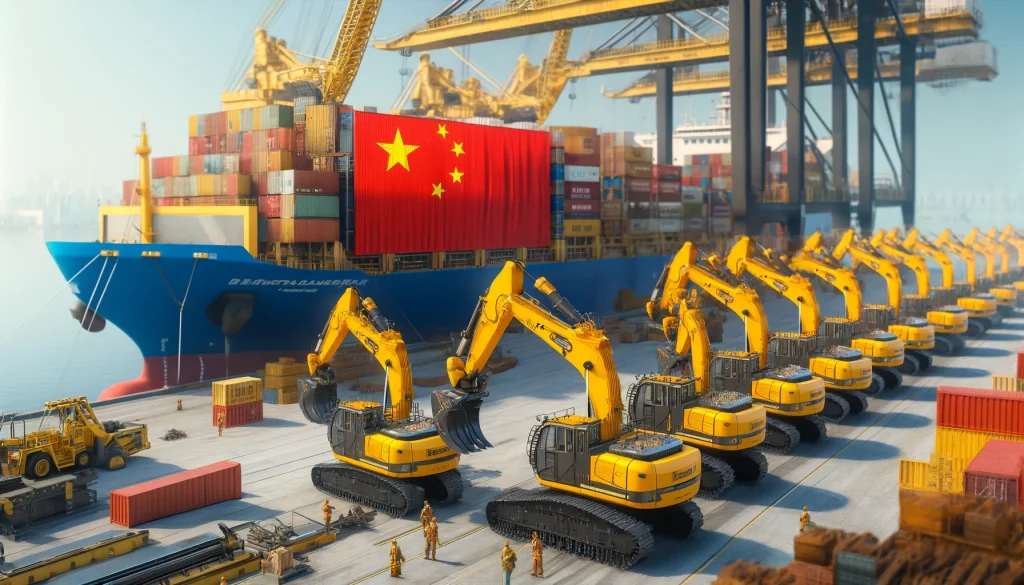
China produces over 55% of the world’s mini excavators, with brands like SANY, XCMG, and Liugong now competing head-to-head with Caterpillar and Komatsu — at prices 20-40% lower. Whether you’re a construction company expanding your fleet, a rental business scaling up, or an entrepreneur entering the equipment market, importing directly from Chinese manufacturers can save you thousands per unit.
This guide covers everything from choosing the right brand and negotiating FOB prices, to shipping logistics, customs duties, and post-arrival inspection — with real price data and practical steps you can follow today.
What Is a Mini Excavator?
A mini excavator (also called a compact excavator or mini digger) is a tracked or wheeled digging machine weighing between 1 and 10 tons. They’re designed for tight spaces where full-size excavators can’t operate — urban construction, landscaping, trenching, demolition, and utility work.
Why Mini Excavators Are in Demand
- Versatility — Accepts multiple attachments: buckets, augers, breakers, grapples, tilting couplers
- Compact footprint — Operates in confined spaces, near walls, inside buildings
- Lower operating costs — 40-60% less fuel consumption than full-size excavators
- Easy transport — Most models fit on a standard trailer (no special permits needed)
- Growing market — Global mini excavator market expected to reach $12.8 billion by 2027
| Weight Class | Typical Uses | Digging Depth | Engine Power |
|---|---|---|---|
| Micro (0.8-1.5 ton) | Garden landscaping, indoor demolition, tight trenching | 1.2-1.8m | 8-15 HP |
| Small (1.5-3 ton) | Residential construction, utility work, small demolition | 2.0-2.8m | 15-25 HP |
| Medium (3-6 ton) | Commercial projects, road work, deep trenching | 3.0-4.0m | 25-45 HP |
| Large mini (6-10 ton) | Heavy construction, large landscaping, quarry work | 4.0-5.5m | 45-75 HP |
Why Import Mini Excavators from China?
Price Advantage
Chinese mini excavators cost 20-40% less than equivalent models from Caterpillar, Kubota, or Komatsu. This isn’t because of lower quality — it’s because of lower labor costs, massive economies of scale, and intense domestic competition among 50+ manufacturers.
| Excavator Class | China FOB Price | Western Brand Price | Savings |
|---|---|---|---|
| 1-ton micro | $2,000-$4,500 | $8,000-$15,000 | 55-75% |
| 2-3 ton small | $4,000-$8,000 | $15,000-$30,000 | 60-75% |
| 5-ton medium | $8,000-$15,000 | $30,000-$50,000 | 55-70% |
| 8-10 ton large | $15,000-$25,000 | $50,000-$80,000 | 50-70% |
Note: Chinese premium brands (SANY, XCMG) are priced 30-50% higher than budget brands but still significantly below Western equivalents.
Manufacturing Quality Has Evolved
Chinese construction equipment has transformed over the past decade:
- SANY — World’s #1 excavator brand by sales volume since 2020. Uses proprietary hydraulics, offers US manufacturing (Georgia), and has strong resale value globally. Both SANY and Sunward ship out of Hunan — our list of forwarders in Changsha covers who handles this heavy-equipment lane.
- XCMG — State-owned giant, world’s top 3 by revenue. Known for reliable, field-serviceable machines using Cummins and Isuzu engines.
- Liugong — Top 10 global brand. SmartHydro load-sensing hydraulics reduce fuel consumption by up to 12%.
- Sunward — Specializes in compact equipment. Strong in Europe with CE-certified machines.
- SDLG (Shandong Lingong) — Volvo joint venture. Budget-friendly with access to Volvo technology.
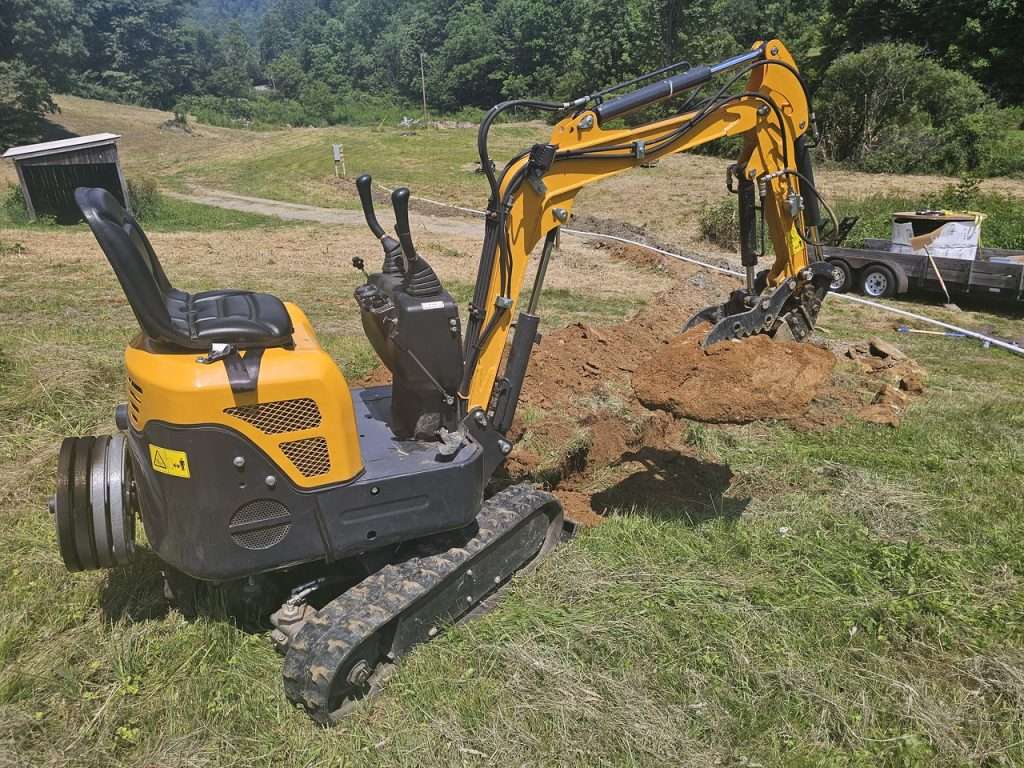
Top 10 Chinese Mini Excavator Brands Compared
| # | Brand | Founded | HQ | Best For | Price Range (1-3t) | Key Engine Partners | Global Presence |
|---|---|---|---|---|---|---|---|
| 1 | SANY | 1989 | Changsha | Best all-round value | $5,000-$10,000 | Yanmar, proprietary | 150+ countries, US factory |
| 2 | XCMG | 1943 | Xuzhou | Budget + reliability | $4,000-$8,000 | Cummins, Isuzu, Yanmar | 190+ countries |
| 3 | Liugong | 1958 | Liuzhou | Fuel efficiency | $4,500-$9,000 | Cummins, Perkins | 130+ countries |
| 4 | Sunward | 1999 | Changsha | Compact/CE-certified | $4,000-$7,500 | Yanmar, Kubota | 80+ countries, strong EU |
| 5 | SDLG | 1972 | Linyi | Budget (Volvo tech) | $3,500-$7,000 | Volvo, Deutz | 60+ countries |
| 6 | Shantui | 1952 | Jining | Budget + durability | $3,000-$6,500 | Weichai, Cummins | 160+ countries |
| 7 | Yuchai | 1951 | Yulin | Micro excavators | $2,500-$5,000 | Yuchai proprietary | 60+ countries |
| 8 | Lovol | 1998 | Weifang | Agriculture crossover | $3,000-$6,000 | Kubota, Perkins | 120+ countries |
| 9 | Hengwang | 2006 | Jining | Lowest price micro | $2,000-$4,500 | Laidong, Kubota | Export-focused |
| 10 | LTMG | 2012 | Xiamen | Small MOQ export | $2,500-$5,000 | Yanmar, Kubota | Export-focused |
Step-by-Step Import Process
Step 1: Define Your Requirements
Before contacting suppliers, document exactly what you need:
- Weight class (1-ton, 3-ton, 5-ton, etc.)
- Attachments (standard bucket, breaker, auger, grapple)
- Engine type (diesel is standard; electric models emerging)
- Cabin (open ROPS, enclosed cab with A/C)
- Emission standard (EPA Tier 4 for US, EU Stage V for Europe, no requirement in many developing markets)
- Quantity (bulk orders unlock 10-20% discounts)
Step 2: Source and Verify Suppliers
| Method | Pros | Cons |
|---|---|---|
| Alibaba / Made-in-China | Huge selection, Trade Assurance | Many trading companies, not factories |
| Direct brand websites (SANY, XCMG) | Guaranteed authenticity | Higher prices, less negotiation room |
| Bauma China trade show (Shanghai, Nov) | See machines in person, negotiate directly | Travel cost, biennial event |
| Canton Fair (Phase 1, April & October) | Meet manufacturers, compare live | Broad focus, less specialized |
| Sourcing agent | Factory verification, QC, logistics | 5-10% commission |
Verification checklist:
- Confirm they’re a factory (not a trading company) — ask for factory tour video
- Request ISO 9001 quality management certificate
- Check CE marking (for EU import) or EPA certification (for US import)
- Ask for reference customers in your market
- Verify on QICHACHA (企查查) for business license and registration date
Step 3: Negotiate Price and Terms
| Negotiation Lever | Typical Impact |
|---|---|
| Order 3-5 units | 8-12% discount |
| Order 10+ units | 15-20% discount |
| Pay 100% upfront (T/T) | 3-5% discount |
| Off-season order (March-May) | 5-10% lower prices |
| Accept stock models (no customization) | $500-$1,500 less per unit |
Standard payment terms: 30% deposit via T/T (bank transfer) + 70% against copy of bill of lading (B/L). For first orders, some factories accept Letter of Credit (L/C) for added security.
Incoterms to discuss:
- FOB (Free on Board) — you arrange shipping from the Chinese port. Best for experienced importers.
- CIF (Cost, Insurance, Freight) — factory handles shipping to your port. Simpler but usually 5-10% more expensive.
- DDP (Delivered Duty Paid) — factory handles everything to your door. Most expensive but zero hassle.
Step 4: Quality Control Before Shipping
Never skip this step. Invest $300-$500 in a pre-shipment inspection:
- Visual inspection — paint, welds, hydraulic lines, tracks, cabin
- Engine test — start-up, idle, full throttle, smoke/emissions
- Hydraulic test — all boom/arm/bucket movements, cylinder leaks
- Measurements — verify weight and dimensions match specs (critical for shipping)
- Documentation check — serial numbers, CE/EPA certificates, user manuals
Shipping Your Mini Excavator from China
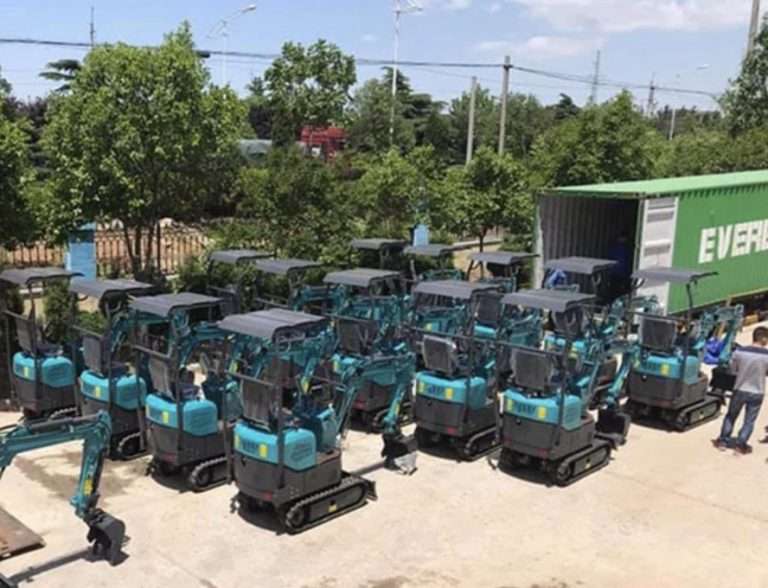
Shipping Methods by Excavator Size
| Excavator Size | Weight | Fits in Container? | Shipping Method | Cost (to EU/US) | Transit Time |
|---|---|---|---|---|---|
| 0.8-2 ton | 800-2,000 kg | Yes — 20ft container | Standard container (FCL) | $2,500-$4,000 | 15-35 days |
| 2-3 ton | 2,000-3,500 kg | Yes — 20ft container | Standard container (FCL) | $2,500-$4,000 | 15-35 days |
| 3-5 ton | 3,500-5,500 kg | Tight — may need 40ft | 40ft container or flat rack | $3,500-$5,000 | 15-35 days |
| 5-8 ton | 5,500-8,000 kg | No | Flat rack container | $4,000-$6,000 | 20-38 days |
| 8-10 ton | 8,000-10,500 kg | No | Flat rack or Ro-Ro | $5,000-$8,000 | 20-38 days |
Multiple units? Two 1.5-ton excavators fit in a single 20ft container. Three 2-ton units fit in a 40ft container. Consolidation reduces per-unit shipping costs by 30-40%.
Key Departure Ports
| Port | Best For | Nearby Manufacturers |
|---|---|---|
| Shanghai | Most brands, fastest schedules | SANY, Sunward, various |
| Qingdao | Shandong-based brands | SDLG, Shantui, Hengwang, LTMG |
| Xiamen | Fujian-based manufacturers | LTMG, various |
| Tianjin | Northern manufacturers | XCMG (via inland), Lovol |
| Ningbo | Zhejiang-based, good EU routes | Various |
Securing the Machine for Transport
Mini excavators must be properly secured inside containers or on flat racks:
- Tracks blocked with wooden chocks and steel chains
- Boom lowered and secured to the chassis
- Hydraulic locks engaged to prevent movement
- Battery disconnected (fire safety requirement)
- Fluids reduced — diesel tank no more than 1/4 full (shipping regulation)
Poor securing is the #1 cause of damage claims on construction equipment. Always use professional loading teams at the origin port.
Customs, Duties & Compliance
HS Code Classification
Mini excavators are typically classified under:
- HS 8429.52 — Self-propelled mechanical shovels, excavators with 360-degree revolving superstructure
- HS 8429.11/19 — Bulldozers and angle-dozers (if applicable)
Duty Rates by Destination
| Destination | Duty Rate | Additional Tariffs | VAT/GST |
|---|---|---|---|
| EU | 0-4.5% | Anti-dumping possible | 19-27% (by country) |
| UK | 0-2.5% | — | 20% |
| US | 0-2.4% | Section 301: +25% on Chinese goods | None (state sales tax varies) |
| Canada | 0-6% | — | 5% GST |
| Australia | 0-5% | — | 10% GST |
| Middle East | 0-5% | — | 5% VAT (UAE/KSA) |
Note: US Section 301 tariffs on Chinese construction equipment add a significant 25% surcharge. Check current rates — these change frequently.
Required Documents
- Commercial invoice — with FOB/CIF value, model numbers, serial numbers
- Packing list — exact weight and dimensions (critical for customs valuation)
- Bill of lading (B/L) — proof of shipment
- Certificate of origin — confirms Chinese manufacture
- CE certificate (EU) or EPA Tier 4 emission certificate (US)
- Pre-shipment inspection report (recommended for all, mandatory for some markets)
- User manual and technical specifications — sometimes required by customs
Full Cost Breakdown Example
Here’s what importing a 3-ton mini excavator from China to Europe looks like:
| Cost Component | Amount | Notes |
|---|---|---|
| Purchase price (FOB) | $6,500 | XCMG or Liugong, standard config |
| Sea freight (20ft container) | $3,200 | Shanghai to Rotterdam, peak season |
| Marine insurance | $150 | 1.5% of CIF value |
| Customs duty (EU 4.5%) | $445 | On CIF value ($9,850) |
| VAT (21% Netherlands) | $2,160 | On CIF + duty ($10,295) |
| Port handling + delivery | $600 | Unloading + truck to warehouse |
| Pre-shipment inspection | $400 | Third-party QC in China |
| Total landed cost | $13,455 | |
| Equivalent Western brand | $30,000-$45,000 | Kubota or Caterpillar equivalent |
| Your savings | $16,500-$31,500 | 55-70% less |
Post-Arrival: Inspection and Setup
Once the excavator arrives at your facility:
- Inspect immediately — Check for transit damage before signing delivery receipt. Photograph everything.
- Compare against specs — Verify serial numbers, weight, and attachments match your order.
- Fill fluids — Top up diesel, hydraulic oil, engine oil, and coolant (shipped with reduced levels).
- Test all functions — Boom, arm, bucket, swing, travel, blade (if equipped). Run for 30 minutes minimum.
- Register warranty — Contact the manufacturer to activate your warranty (typically 1-2 years or 2,000 hours).
- Report issues within 48 hours — Damage claims and warranty issues must be filed quickly with both the shipping company and the manufacturer.
Common Mistakes to Avoid
- Buying on price alone — The cheapest factory often has the worst after-sales support. A $500 savings means nothing if you can’t get parts.
- Ignoring emission standards — A machine without CE (EU) or EPA Tier 4 (US) certification cannot be legally operated. This is non-negotiable.
- Skipping pre-shipment inspection — The single most common mistake. A $400 inspection prevents $5,000+ in rejected or defective goods.
- Wrong container size — Providing pre-disassembly dimensions instead of actual shipping dimensions leads to booking the wrong container and costly rebooking.
- Not checking destination port capabilities — Not all ports handle flat rack or heavy-lift cargo. Confirm before booking.
- Forgetting spare parts — Order a basic spare parts kit (filters, hydraulic hoses, track pads) with your machine. Parts from China take 4-8 weeks to arrive later.
- Paying 100% upfront to an unverified supplier — Standard terms are 30/70. Use Trade Assurance or L/C for first orders.
Why Work with SINO Shipping?
Importing heavy equipment from China involves complex logistics that general freight forwarders often get wrong. SINO Shipping specializes in construction equipment transport:
- Factory pickup — We collect from the manufacturer’s yard, anywhere in China
- Professional loading — Our teams secure excavators with proper blocking, chaining, and documentation
- Flexible shipping — Container, flat rack, Ro-Ro, or breakbulk depending on your needs
- Customs expertise — Full documentation preparation, HS code classification, and duty optimization
- Door-to-door delivery — From Chinese factory to your warehouse, including heavy equipment unloading
For a tailored quote on your mini excavator import, get in touch with our team.
For more on shipping heavy machinery from China, see our construction equipment shipping guide and oversized cargo handling guide.
ReferenceGlossary· 27 terms
Search a term, or jump by letter.
- B/L
- Bill of Lading. Transport document issued by the carrier; evidence of contract and (for negotiable B/L) title to the goods.
- breakbulk
- Non-containerized cargo (e.g. pallets, crates) loaded directly onto the vessel. FOB was designed for breakbulk; for containers, FCA often fits better with CY/CFS hand-off.
- CE
- Conformité Européenne. EU mandatory marking for products sold in the EEA. Does not transfer to Japan—PSE and TELEC are separate regimes.
- Certificate of Origin
- Document certifying where goods were produced. Often required for preferential duty rates or by the importer.
- CIF
- Cost, Insurance and Freight. Sea and inland waterway only—no air. Seller pays freight and minimum insurance (typically ICC C) to the named port; buyer clears import and pays duties. Risk transfers when goods are on board the vessel.
- Commercial Invoice
- Document stating value, description, and terms of the goods; required for customs and payment.
- consolidation
- Combining several LCL shipments into one container at origin. Reduces cost per CBM; adds CFS time.
- Customs Duty
- Import tax levied by Kuwait Customs on goods entering the country, typically calculated as a percentage of the shipment’s value.
- DDP
- Delivered Duty Paid. Seller pays all costs to the buyer's door, including clearance, duties, and Consumption Tax. True DDP means the recipient pays nothing at delivery.
- door-to-door
- Service from shipper's door to consignee's door. The forwarder or carrier coordinates all legs, including pickup and delivery.
- duty
- Import duty. Tax levied by customs on imported goods, based on HS code, value, and origin.
- EPA
- Economic Partnership Agreement. Japan's FTAs (e.g. Japan–China, RCEP). Preferential duty rates apply if origin rules are met and a Certificate of Origin is provided.
- FCL
- Full Container Load. You book an entire container (e.g. 20GP or 40HC); only your cargo inside.
- FOB
- Free On Board. Seller delivers to the ship and clears export; buyer arranges freight and import from ship's rail. Risk transfers when goods are on board the vessel. Sea freight only—use FCA for air. For containers, the 'on board' moment is often unclear; FCA (CY/CFS) can be cleaner.
- forwarder
- Freight forwarder. Company that books transport, arranges documentation, and often coordinates customs on your behalf.
- GST
- Goods and Services Tax. New Zealand's value-added tax applied to most imports, currently at 15%.
- HS Code
- Harmonized System code. International product classification used for customs; determines duty rate and any restrictions.
- Incoterms
- International Commercial Terms. Standard rules (EXW, FOB, CIF, DDP, etc.) defining who pays, who clears customs, and when risk transfers at each stage.
- landed cost
- Total cost to get goods to the final destination: transport, handling, customs, duties, taxes, and last-mile. Use it to compare modes, not headline rate alone.
- Packing List
- Document listing contents, weights, and packaging of each package; used for customs and cargo handling.
- pickup
- Factory collection. Truck books, loads at origin, and transports cargo to the CFS, CY, or airport. Distance, multi-supplier stops, and cargo readiness affect cost.
- REACH
- Registration, Evaluation, Authorisation and Restriction of Chemicals (EC 1907/2006). EU regulation controlling chemicals in products imported into Portugal.
- rebooking
- Booking a new delivery appointment after missing the original slot. Triggers rebooking fee and delay (often 2–3 days in peak).
- Sales Tax
- Tax imposed on imported goods in Iraq, collected at customs alongside import duty.
- State Sales Tax
- A state-level tax applied to goods sold within the United States, varying by state and sometimes collected on imports.
- surcharge
- Additional fee on top of base freight (e.g. BAF, THC, fuel, security). Always ask what's included in 'all-in'.
- VAT
- Value Added Tax. Cambodia's standard consumption tax applied to imports, currently at 10%.
No term matches your search.