

In this guide
- 01 5 Best Shipping Companies from…
- 02 How We Ranked These Companies
- 03 Which Provider Type Fits Your D…
- 04 1. SINO Shipping
- 05 2. Senghor Logistics
- 06 3. ZGGShip
- 07 4. Al Fares Cargo
- 08 5. DHL, FedEx and UPS
- 09 Also Worth a Look: 5 More Names…
- 10 China→Dubai Rates and Transit T…
- 11 Jebel Ali or Mina Rashid? DXB o…
- 12 Free Zone (JAFZA) vs Mainland D…
- 13 China-Based or Dubai-Based Comp…
- 14 Verify Any Shipping Company Bef…
- 15 Make the Final Call
- Direct sea freight Shanghai→Jebel Ali runs 18–22 days port-to-port, with a 20ft container booking around $1,450–2,900 in mid-2026 depending on port pair and season.
- Air cargo to Dubai (DXB/DWC) books at roughly $3.30–6.50/kg with 3–7 days transit; couriers charge $7.50–10.50/kg but deliver door-to-door in 1–9 days — the break-even sits near 100 kg.
- We compare 5 named providers across real use cases — multi-supplier consolidation, Amazon FBA UAE, Dubai-side clearance, small-parcel courier — with the selection criteria no competing list publishes.
- Cargo entering the Jebel Ali free zone (JAFZA) defers the 5% duty entirely until goods leave the zone — the mechanism behind Dubai's re-export model to the GCC and Africa.
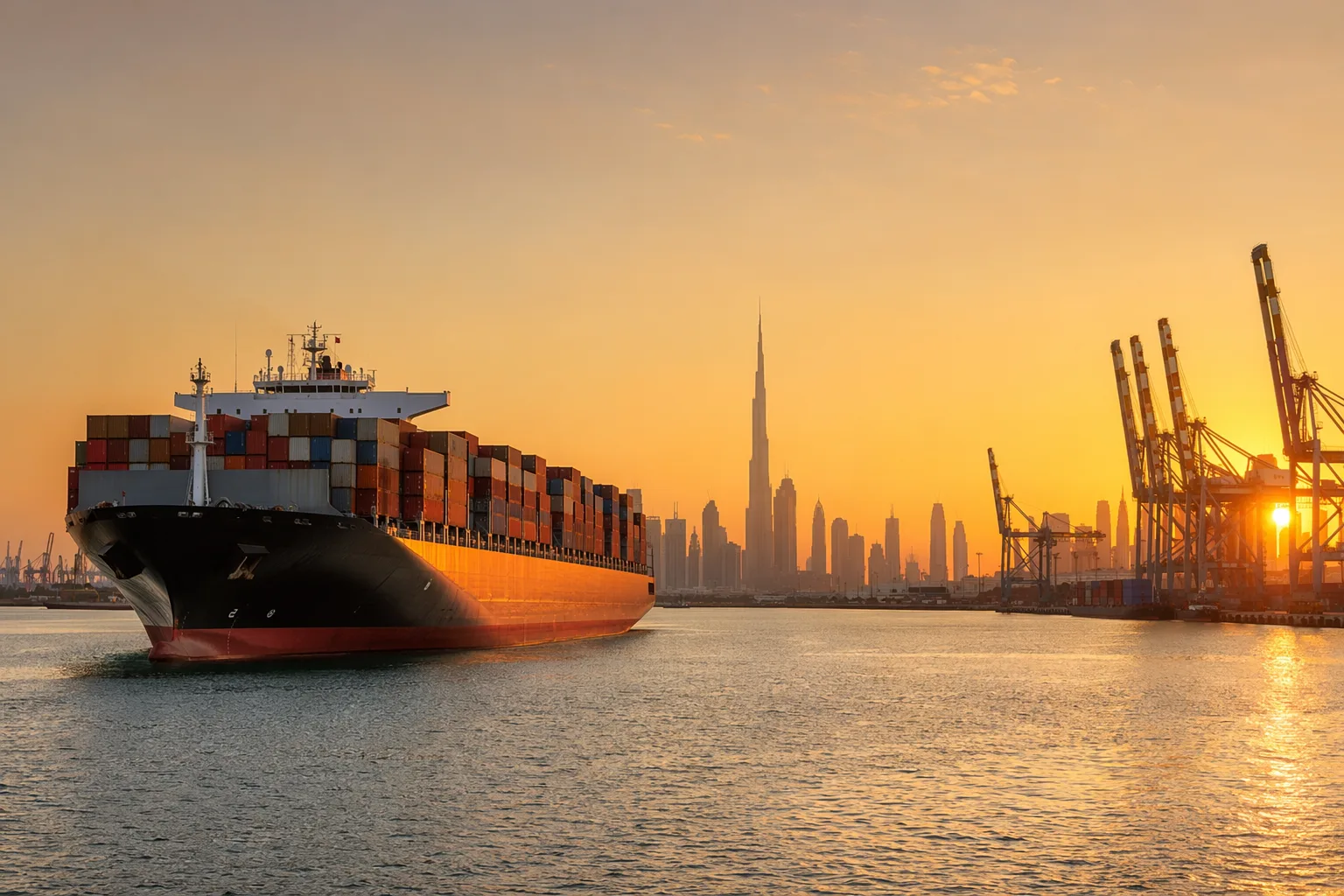
Dubai imported its way into becoming the Gulf’s trading capital: the UAE bought roughly $53 billion of Chinese goods in 2024, and the bulk of it lands at Jebel Ali — the largest port between Rotterdam and Singapore — before fanning out to the GCC and Africa. Plenty of companies want to move your share of that flow, and every “top shipping companies” list you’ll find either names companies with zero pricing data or publishes rates while naming nobody but its own author. This page does both jobs at once. Full disclosure: SINO Shipping is our platform — we rank ourselves #1, explain exactly why, and profile 4 genuinely strong alternatives with checkable facts and honest cons. For lane-wide fundamentals — monthly rates, Mirsal 2 customs, VAT, certifications — use our complete China–UAE shipping guide. This page answers a narrower question: which company should move your cargo to Dubai.
The 5 Best Shipping Companies from China to Dubai at a Glance
| Company | Base | Specialty | DDP? | Best for |
|---|---|---|---|---|
 SINO Shipping | Hong Kong + 6 China offices | End-to-end SME freight, consolidation, DDP | ✅ | First-time and SME importers, traders, multi-supplier orders |
 Senghor Logistics | Shenzhen | Multi-supplier consolidation into one UAE shipment | ✅ | Buyers with several small suppliers |
 ZGGShip | Shenzhen (since 2010) | Amazon FBA UAE + GCC re-export | ✅ | FBA UAE sellers, re-export traders |
 Al Fares Cargo | Dubai | UAE-side clearance and door delivery | ✅ | Importers who want a local Dubai agent |
 DHL / FedEx / UPS | Global | Express courier, 1–9 days | — | Samples and parcels under ~100 kg |
How We Ranked These Companies (Selection Criteria)
No competing list on this query explains how its ranking was built — the exact-match “top 5” that currently leads the SERP names five companies without a single rate, transit time, or port. We do rank ourselves first, so here is precisely what we scored; re-weight it for your own situation:
- China pickup network — can the company collect from your actual supplier cities (Yiwu, Guangzhou, Shenzhen, Ningbo…) and consolidate, or does it quote only port-to-port?
- Dubai clearance capability — a named clearing channel for Jebel Ali and DXB, Mirsal 2 declarations filed correctly, and the ability to deliver to both mainland and free-zone addresses.
- DDP done properly — duty and VAT itemized against your TRN, not “included” in a price too low to contain them.
- Specialization with evidence — FBA UAE, dangerous goods, consolidation, re-export: a claimed niche should come with a verifiable process.
- Verifiable track record — founding dates, offices, and claims that can be checked against published sources. Where sources conflict or data is simply absent, we say so in the profile.
One honest scope note: this is a Dubai-lane comparison for SME importers and traders. If you tender five containers a week across global lanes, you want an enterprise forwarder (Kuehne + Nagel, DHL Global Forwarding, DSV) — none of the specialists below, including us, is built for that.
Which Provider Type Fits Your Dubai Shipment?
Match your profile before reading the entries — the step every other list skips:
- First import, or a full order from one or several factories → a China-based full-service forwarder (#1) that picks up, consolidates, ships, clears, and delivers on one contract.
- Several small suppliers, none filling a container → a consolidation specialist (#1, #2) with its own China warehouses.
- Selling on Amazon.ae or re-exporting to the GCC → the FBA/re-export specialist (#3), or #1 with a free-zone routing.
- You buy FOB and want control at destination → a Dubai-side agent (#4) clearing and delivering locally.
- Samples, documents, restocks under ~100 kg → the courier tier (#5), no forwarder needed.
1. SINO Shipping — Best Overall from China to Dubai (Full Disclosure: That’s Us)
Best for: SME importers and Gulf traders who want one accountable partner from factory floor to Dubai door | HQ: Hong Kong, with offices in Shenzhen, Guangzhou, Shanghai, Ningbo, Tianjin, and Qingdao
SINO Shipping is the digital brand of FS International, a Hong Kong-headquartered freight group with offices in every major Chinese export cluster. On the Dubai lane that footprint matters more than on most: Gulf buyers typically source from several suppliers at once — electronics in Shenzhen, hardware in Ningbo, textiles in Guangzhou — and your consolidation cost depends on how close your forwarder’s warehouses are to those factories. We run FCL and LCL sea freight to Jebel Ali, air cargo to DXB and DWC, express, and DDP door-to-door covering Dubai mainland and free-zone deliveries alike.
What that looks like in practice, from a recent multi-supplier file our South China team handled: a trading company bought a full production line split across three suppliers in three provinces (Jiangmen in Guangdong, Jiujiang in Jiangxi, Zhengzhou in Henan). Our team arranged pickup from each factory, handled export declaration documents for the supplier that had never exported, consolidated everything at our Guangzhou (Baiyun) warehouse, compared carrier offers on the client’s behalf — the COSCO booking came in over $1,400 below the CMA CGM alternative — added cargo insurance at roughly 0.3% of cargo value, and advised shipping before the October peak, when rates on these trade lanes typically jump about 20%. The identical process applies to Dubai-bound consolidations: one container, one bill of lading, one Mirsal 2 entry at Jebel Ali instead of three.
The other thing we do differently is quote hygiene. Our Dubai-lane quotes itemize ocean or air freight, origin charges, destination handling, the 5% duty, and 5% VAT on separate lines, so you can compare them against the benchmarks on this page — and against any competitor’s number.
Pros: offices near every major supplier region; consolidation in our own warehouses; transparent duty/VAT itemization for DDP; free-zone and mainland delivery both handled; replies within 24 hours on WhatsApp, WeChat, or email. Cons: we’re built for SMEs and mid-size traders — global tender programs get better unit economics at the enterprise giants; we don’t publish an instant online booking API.
The honest way to test any company on this list is one real quote. Request a China→Dubai quote and check it line by line against the rate table below.
2. Senghor Logistics — Multi-Supplier Consolidation into One Dubai Shipment
Best for: buyers ordering from several small Chinese suppliers who need one combined UAE shipment | HQ: Shenzhen, 10+ years claimed
Senghor Logistics is a Shenzhen forwarder whose UAE pitch centers on exactly one problem: you’ve bought from four suppliers on Alibaba, none of them fills a container, and shipping four LCL lots separately would multiply your fixed fees. Senghor collects from multiple suppliers, warehouses the cargo, and consolidates it into a single sea or air shipment — FCL, LCL, or DDP — to the UAE. It currently sits at #1 in the exact-match listicle that leads this SERP, and unlike most names on that list, it also ranks with its own China→Dubai route page, which suggests the lane is core business rather than a landing page.
Pros: consolidation-first service model that matches how Gulf traders actually buy; sea and air both offered; DDP available for hands-off customs. Cons: publishes no rates, transit commitments, or founding documentation — its “10+ years” is self-reported; no visible Dubai-side office, so destination handling runs through partners.
3. ZGGShip — Amazon FBA UAE and GCC Re-Export Specialist
Best for: Amazon.ae sellers and traders re-exporting from Dubai across the GCC | HQ: Shenzhen, operating since 2010
ZGGShip is the only company in this SERP tied to the two intents that make Dubai different from every other destination city: Amazon FBA UAE and re-export. It delivers directly into UAE fulfillment centers, files DDP entries with VAT and TRN declarations — the paperwork detail most China-side DDP shops get wrong on the UAE — and moves goods onward from the UAE to other GCC countries. Operating since 2010, it predates the entire post-pandemic wave of DDP startups on this lane.
If your model is “land in Dubai, sell across the Gulf,” pair a provider like this with a free-zone routing (see the JAFZA section below) so duty is only ever paid on the share of goods entering the UAE mainland. For the Amazon mechanics on the China side — prep, labeling, carton rules — our Amazon FBA shipping guide covers the process end to end.
Pros: rare genuine FBA UAE specialization; TRN/VAT-correct DDP; GCC onward distribution; 15+ years of operating history. Cons: niche-first — general cargo and large FCL programs are not its center of gravity; publishes no rate table; UAE presence is partner-based rather than own offices.
4. Al Fares Cargo — The Dubai-Side Clearing and Delivery Agent
Best for: importers buying FOB who want a local UAE company handling arrival, clearance, and delivery | HQ: Dubai
Al Fares Cargo Service is the strongest Dubai-based entry on this lane: a local forwarder running air and sea imports from China into Dubai, Abu Dhabi, and Sharjah, with door-to-door delivery and GCC coverage. Unusually for a destination agent, it also monitors shipments from Chinese factories — useful when your supplier ships FOB and you want independent eyes at origin. Being Dubai-side is its real edge: when a container hits an inspection at Jebel Ali or a Mirsal 2 declaration needs correcting, a company whose staff physically work in Dubai resolves it faster than any overseas hotline. Local agents also tend to know the practical side of last-mile rules in the UAE — duty exemptions, pallet standards, delivery scheduling around UAE holidays.
Pros: local accountability in Dubai; clears and delivers across the Emirates and the GCC; factory monitoring at origin is rare for a destination agent. Cons: publishes no rates, transit times, or founding data; origin-side pickup and consolidation depth in China can’t match a Shenzhen-based network — many importers pair an agent like this with a China-side forwarder.
5. DHL, FedEx and UPS — The Courier Tier from China to Dubai
Best for: samples, documents, and urgent parcels under about 100 kg | Type: global express integrators
For small shipments, the fastest “shipping company from China to Dubai” isn’t a freight forwarder at all. The express integrators run daily lift into DXB and deliver door-to-door in 1–9 days, customs included. Published China→UAE benchmark pricing (April 2026 data) puts DHL at $8.50–10.50/kg, FedEx at $7.50–9.80/kg, and UPS at $7.80–9.60/kg for shipments above 21 kg — two to three times the per-kilo cost of consolidated air freight, but with no fixed handling fees, which is why couriers win small.
The arithmetic that matters: below roughly 45–100 kg, courier all-in cost beats air freight once you add the forwarder’s fixed clearance and handling charges. Above 100 kg, consolidated air cargo at $3.30–6.50/kg wins clearly; above 2–3 CBM, sea freight embarrasses both. One UAE-specific note: shipments valued below AED 1,000 clear duty-free, which keeps sample flows genuinely cheap. Booking through a forwarder’s courier account (ours included) usually beats retail counter rates by 30–50% — see our express shipping guide for how discounted courier programs work.
Pros: fastest option on the lane; fully tracked; customs handled; no fixed fees on small parcels. Cons: per-kilo pricing becomes punitive above ~100 kg; volumetric weight rules sting bulky-light cargo; batteries and DG face strict acceptance limits.
Also Worth a Look: 5 More Names on This Lane
Five companies that didn’t make the top table but deserve a mention for specific cases:
- Gerudo Logistics (Guangzhou, 15+ years) — the pick for dangerous goods, chemicals, cold-chain, and machinery to Dubai; DG documentation is a specialty most general forwarders quietly subcontract.
- DDPCHAIN (Shenzhen, founded 2019) — a young, marketing-sharp DDP operator publishing indicative rates (DDP air from $3.82/kg, DDP sea $76–153/CBM); its track record spans one demand cycle.
- Winsky Freight (Shenzhen, est. 2013) — publishes the most granular dated China–UAE rate tables in this SERP; a solid SME option, UAE-wide rather than Dubai-focused.
- Alliance Shipping (Dubai, Business Village) — a local forwarder that publishes a flat rate table and clean duty math; single flat rates (air at $1.60/kg) look more like teasers than bookable prices, so treat them as conversation starters.
- Reef Shipping (Dubai International City) — owns the door-to-door household and personal effects niche, with pickup coverage from ~20 Chinese cities and a documented 7-step process; publishes no rates.
China→Dubai Rates and Transit Times — Checked November 2026
This is the table the exact-match lists don’t publish. Ranges consolidate our own lane data with the published figures from the competitors profiled above — use them to sanity-check any quote, and see the full UAE country guide for monthly-updated rates and the complete customs picture.
| Service | Typical price (Nov 2026) | Transit | When it wins |
|---|---|---|---|
| Sea LCL to Jebel Ali | $30–60/CBM + fixed destination fees | 25–35 days door | 2–10 CBM |
| Sea FCL 20ft to Jebel Ali | $1,450–2,900 | 18–22 days port-to-port direct | 10+ CBM, planned stock |
| Sea FCL 40ft/40HQ | $2,600–3,800 | 18–22 days port-to-port direct | 20+ CBM, best $/unit |
| DDP sea (all-in) | $76–153/CBM | 35–45 days door | No UAE entity, hands-off duty |
| Air freight to DXB/DWC | $3.30–6.50/kg | 3–7 days door | 100–500 kg, value-dense goods |
| DDP air (all-in) | from ~$3.80–4.05/kg | 6–10 days door | Fast restocks, duty included |
| Express courier | $7.50–10.50/kg (21 kg+) | 1–9 days door | Under ~100 kg, samples |
Three notes our pricing team repeats on this lane. First, the spread between sources is itself information: marketplace door-to-door totals (a Guangzhou→Dubai 20ft at $2,800–3,760 all-in) run well above forwarders’ port-to-port teasers — always confirm what a number includes. Second, routing risk is real: Red Sea disruptions have added up to 10 days to some Asia–Gulf rotations since 2024, so ask which routing your quote assumes. Third, seasonality: rates climb around Chinese New Year and the August–October peak — the +20% October surge our team flagged in the consolidation case above is typical, and booking 3–4 weeks ahead of peak is the cheapest hedge available. Full cost mechanics live in our freight costs from China guide.
Jebel Ali or Mina Rashid? DXB or DWC? The Dubai Routing Layer
No competing list covers the operational layer under every quote: which Dubai gateway your cargo actually uses, and why it changes cost and speed.
Sea: Jebel Ali is the default, and usually the right one. Jebel Ali (operated by DP World) handles the overwhelming majority of China–Dubai container traffic — together with Abu Dhabi’s Khalifa port, the UAE gateways receive over 1.5 million TEU a year from China, with weekly direct sailings from Shanghai, Ningbo, Shenzhen, and Qingdao. Direct Shanghai→Jebel Ali services run 18–22 days; the fastest South China pairs (Shekou→Jebel Ali) can do around 13 days port-to-port. Transshipment via Singapore or Colombo — common from secondary Chinese ports — adds 5–7 days and up to 10% cost. Mina Rashid, Dubai’s older city port, now serves cruise and specialty traffic; if a forwarder quotes it for containers, ask why. Port choice mechanics are covered in our best shipping lanes guide.
Air: DXB for speed and frequency, DWC for freighters. Dubai International (DXB) takes most bellyhold cargo on the dense passenger schedules of Emirates and Chinese carriers — direct Shanghai/Guangzhou/Shenzhen services deliver in 3–4 days airport-to-airport. Al Maktoum (DWC), next to Jebel Ali, is the dedicated freighter hub: marginally slower handling into the city, but it sits beside JAFZA — convenient when your air cargo feeds a free-zone operation. Your forwarder should choose based on your delivery address, not their habit.
Why this matters for choosing a company: a forwarder that can explain its Jebel Ali clearance channel, name the difference between a DXB and DWC arrival, and ask whether your delivery address is mainland or free zone before quoting is demonstrating operational depth. One that quotes “Dubai” generically is reselling someone else’s capacity.
Free Zone (JAFZA) vs Mainland Delivery — and the Re-Export Play
The single biggest Dubai-specific decision — untouched by every other list on this query — is where your goods legally enter.
- Mainland import: the standard flow. Your shipment clears Mirsal 2, pays 5% duty on CIF value plus 5% VAT (a combined effective load of about 10.25%, since VAT applies on the duty-inclusive value), and delivers anywhere in the UAE. Requirements: a UAE trade license and importer code; VAT registration (TRN) applies above the mandatory threshold. Full mechanics in our UAE import duties and taxes guide.
- Free-zone import (JAFZA and others): goods entering the Jebel Ali Free Zone are duty-suspended — no duty, no import VAT, as long as they stay in the zone. Duty is only triggered on the portion that later moves into the mainland. Goods re-exported from the zone to Saudi Arabia, Qatar, Kuwait, Oman, Bahrain, or African markets never pay UAE duty at all.
That second flow is why Dubai exists as a trading hub: buy in China, land in JAFZA, break bulk, and re-export across the GCC and East/West Africa, paying duty only where goods finally enter a customs territory. If that’s your model, it should drive your choice of shipping company — you need a provider that handles free-zone bills of entry and zone-to-zone transfers (us, ZGGShip for GCC onward flows, or a capable Dubai-side agent), not just a port-to-port rate. If you sell purely inside the UAE, mainland entry with a clean DDP arrangement is simpler and usually cheaper than maintaining a zone presence.
China-Based or Dubai-Based Company? (Or Both)
The question one competitor’s FAQ raises and nobody answers properly. The honest framework:
Choose China-based when your complexity is at origin. Multiple suppliers to coordinate, factory pickups across provinces, consolidation, export declarations, supplier documents that need chasing in Mandarin — that work physically happens in China, and a Deira office can’t do it. This covers most first-time importers and consolidation buyers.
Choose Dubai-based when your complexity is at destination. You buy FOB from one reliable supplier who handles export, but you need Mirsal 2 expertise, free-zone transfers, duty-exemption paperwork, or scheduled delivery into your own distribution. A local agent with staff at Jebel Ali earns its fee in the last 50 kilometers.
The practical optimum for most SME importers is one contract covering both ends — either a China-based forwarder with a contractually locked Dubai clearing partner (our model), or a Dubai forwarder with real origin offices in China. What you’re avoiding is the two-contract gap: when origin and destination providers are independent, arrival problems become a blame exchange across time zones, with your container on demurrage while they argue. Whoever you pick, ask one question: “Who exactly files my Mirsal 2 entry, and who do I call if the container is held?” A single accountable answer is worth more than $100 off the ocean rate. Our guide on how to choose a freight forwarder turns this into a full evaluation checklist.
How to Verify Any Shipping Company Before You Wire Money
Almost nothing on the competing lists is verifiable — most entries carry no founding dates, licenses, or checkable claims. Five checks that take about ten minutes:
- Chinese business license (for China-side companies): ask for the registration and verify the entity name matches the bank account you’re asked to pay. Mismatched beneficiary names are the most common scam tell on this lane.
- UAE trade license (for Dubai-side companies): every legitimate UAE forwarder holds a license from the Dubai DED or a free-zone authority — ask for the number; they can be checked online.
- Duty math in the quote: with 5% duty plus 5% VAT, a DDP price that shows no roughly-10% tax component on your CIF value means under-declaration — and Dubai Customs holds the importer liable, not the forwarder.
- Named clearance channel: ask who files the Mirsal 2 entry. “Our partner handles it” without a name is a red flag; a real answer includes a company you can look up.
- Standard trading conditions in writing, plus a proper debit note before payment — legitimate forwarders on both sides of this lane operate this way without being asked.
Rates 30%+ below every benchmark in this article, personal-email-only contact, and pressure to prepay in full before any booking exists should each end the conversation. Our forwarder red flags guide keeps the fuller list.
How to Make the Final Call
Shortlist two companies from different categories — say, a China-based consolidator and a Dubai-side agent, or us and a courier for your small lots — and send both the identical inquiry: product, HS code if known, carton dimensions, weight, supplier city, and whether delivery is mainland or free zone. Compare itemized totals, not headline rates; the FCL vs LCL breakdown and air vs express comparison show exactly which line items to look for. Then test the winner with one small shipment before trusting it with your peak-season volume.
Rates and company facts checked in November 2026. If a claim on this page conflicts with what a provider tells you directly, ask them to reconcile it in writing — the quality of that answer is itself part of your evaluation.
ReferenceGlossary· 32 terms
Search a term, or jump by letter.
- 40HQ
- 40-foot High Cube container. Extra height for bulky cargo, ~76 CBM.
- all-in
- Quote that includes the main cost components (e.g. freight + handling + clearance). Always confirm what's included so you're not comparing a partial quote to a full one.
- cargo insurance
- Insurance covering loss or damage to goods in transit. Arrange it from the moment risk transfers to you—under EXW that's at the factory gate; under FOB at the ship's rail.
- CBM
- Cubic metre. Standard unit for shipping volume; used for LCL pricing and container capacity.
- Chinese New Year
- A significant holiday in Singapore, during which port and logistics operations may be delayed.
- CIF
- Cost, Insurance and Freight. Sea and inland waterway only—no air. Seller pays freight and minimum insurance (typically ICC C) to the named port; buyer clears import and pays duties. Risk transfers when goods are on board the vessel.
- clearance
- Customs clearance. Process of presenting goods and documents to customs and obtaining release for import or export. Export clearance (who files it) is the key difference between EXW and FOB.
- consolidation
- Combining several LCL shipments into one container at origin. Reduces cost per CBM; adds CFS time.
- DDP
- Delivered Duty Paid. Seller pays all costs to the buyer's door, including clearance, duties, and Consumption Tax. True DDP means the recipient pays nothing at delivery.
- demurrage
- Charge when cargo stays at the terminal beyond the free time allowed. Often due to late docs or delayed pickup.
- DG
- Dangerous goods. Cargo requiring special handling (batteries, chemicals, flammables). MSDS and DG declaration often required for air and some sea shipments.
- door-to-door
- Service from shipper's door to consignee's door. The forwarder or carrier coordinates all legs, including pickup and delivery.
- DP World
- DP World. Global logistics company operating major UAE ports, including Jebel Ali, responsible for cargo handling and terminal operations.
- Dubai Customs
- Dubai Customs. The main customs authority responsible for regulating imports and exports through Dubai, including cargo clearance and duty collection.
- duty
- Import duty. Tax levied by customs on imported goods, based on HS code, value, and origin.
- export declaration
- Document filed with customs to clear goods for export. Lists contents, value, HS codes, and destination. Under EXW the buyer is responsible; under FOB the seller.
- FCL
- Full Container Load. You book an entire container (e.g. 20GP or 40HC); only your cargo inside.
- FOB
- Free On Board. Seller delivers to the ship and clears export; buyer arranges freight and import from ship's rail. Risk transfers when goods are on board the vessel. Sea freight only—use FCA for air. For containers, the 'on board' moment is often unclear; FCA (CY/CFS) can be cleaner.
- forwarder
- Freight forwarder. Company that books transport, arranges documentation, and often coordinates customs on your behalf.
- HS Code
- Harmonized System code. International product classification used for customs; determines duty rate and any restrictions.
- Jebel Ali Port
- Jebel Ali Port. The largest container port in the Middle East, located in Dubai and a major entry point for shipments from China.
- last-mile
- Final leg of delivery from port, airport, or warehouse to the consignee's address. May include remote-area or residential surcharges.
- LCL
- Less than Container Load. Your cargo shares a container with others; priced per CBM (plus CFS and handling at both ends).
- Mirsal 2
- Mirsal 2. Dubai Customs’ electronic cargo clearance platform used for submitting import/export declarations and tracking shipments.
- New Year
- Japan: late December to early January when many businesses, ports, and warehouses close or reduce operations. Plan shipments to avoid arrival during this window; expect backlog after reopening.
- origin charges
- Fees at the export port: THC, handling, documentation, CFS (for LCL). Under FOB these can be bundled and opaque; under FCA the split is clearer since the buyer books freight and the seller's scope ends at delivery.
- pickup
- Factory collection. Truck books, loads at origin, and transports cargo to the CFS, CY, or airport. Distance, multi-supplier stops, and cargo readiness affect cost.
- port-to-port
- Service from origin port to destination port only. You (or your forwarder) arrange pickup and delivery separately.
- TEU
- Twenty-foot Equivalent Unit. Standard measure of container capacity (one 20ft box = 1 TEU).
- transshipment
- Cargo is transferred at an intermediate port before reaching the final destination. Adds another terminal, cut-off, and handoff—more variability than direct sailings.
- VAT
- Value Added Tax. Cambodia's standard consumption tax applied to imports, currently at 10%.
- volumetric weight
- Billable weight used by air and express when cargo is light but bulky. (Volume in cm³ ÷ divisor.) Can be 2–3× actual weight; check how your carrier calculates it.
No term matches your search.