

In this guide
- 01 Top 7 at a Glance
- 02 How We Ranked These Companies
- 03 1. SINO Shipping
- 04 2. DDPCH / DDPCHAIN
- 05 3. Dantful
- 06 4. Basenton Logistics
- 07 5. Bansar
- 08 6. Hong Ocean
- 09 7. CFC (Cargo From China)
- 10 Direct Sailing or Transshipment…
- 11 Why a 20ft Container Is Quoted…
- 12 5-Point Scorecard: Vetting Any…
- 13 Bottom Line
- No genuinely comparative list exists for this corridor: the two competing pages titled 'best freight forwarder China to Qatar' each name exactly one company — themselves. This page names, scores and criticises all seven.
- Published 20ft rates to Hamad Port range from $1,550 to $4,550 across providers — most of that spread is freight-only vs DDP all-in pricing and direct sailing vs transshipment via Jebel Ali, not company quality.
- Hamad Port moved 1.46M TEU in 2025 with roughly half of it transshipment, so whether your forwarder books a direct CMA CGM/PIL service or a Jebel Ali relay decides if your transit is ~19 days or 30+.
- Match the company type to your profile: DDP parcel specialists (DDPCH), rate-table publishers (Basenton, Dantful), carrier-heavy FCL bookers (Bansar), LCL groupage (CFC) — or a full-service forwarder with offices in every major Chinese port city.
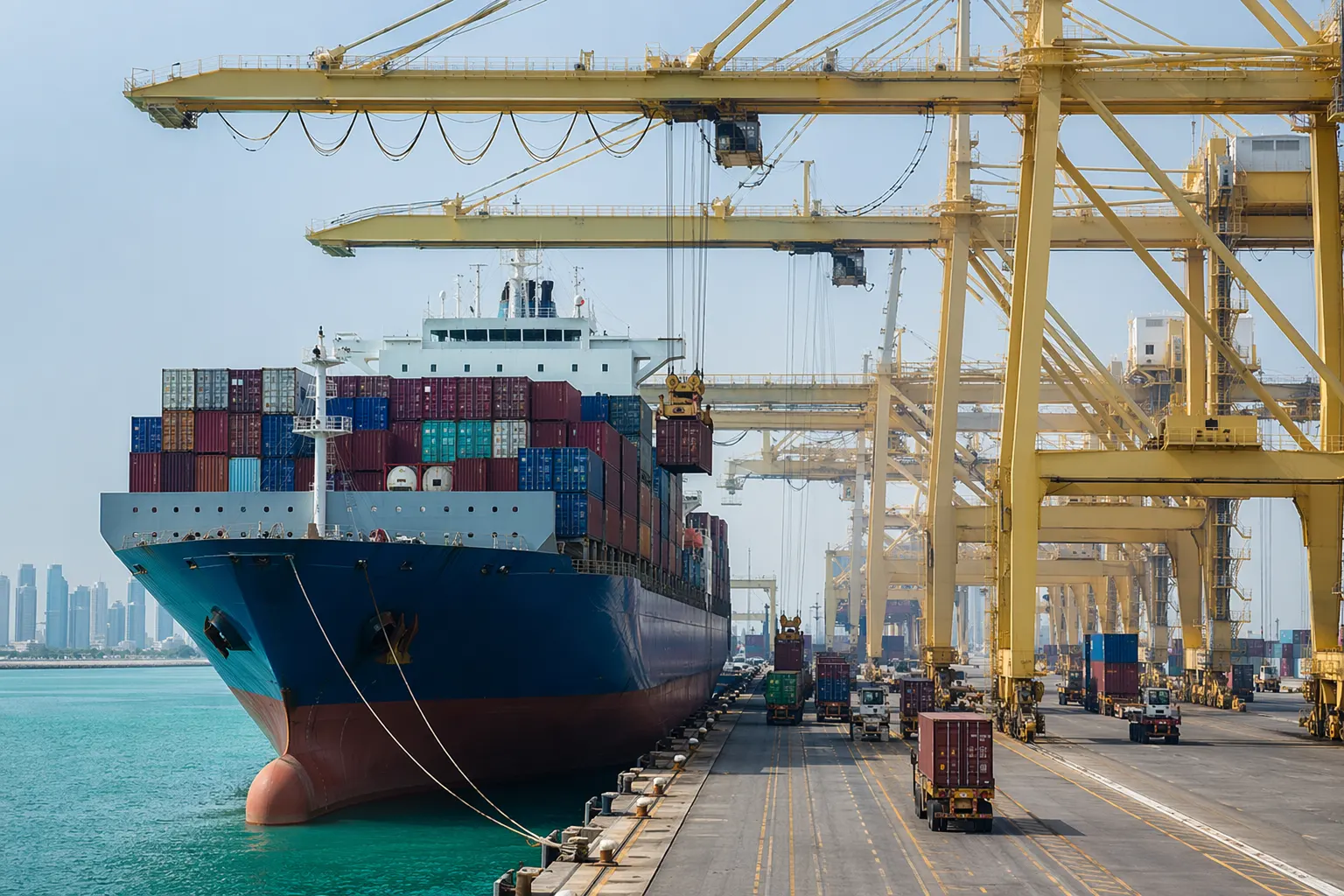
Search for the best shipping companies from China to Qatar and you’ll find something odd: not a single page actually compares companies. Two of the top results are literally titled “best freight forwarder from China to Qatar” — and each names exactly one provider: itself. The rest are single-brand rate guides with wildly contradicting numbers (a 20ft container is quoted anywhere from $1,500 to $4,550 across the first page of Google). So here is the comparison that doesn’t exist yet, with two things no competitor offers: full disclosure — SINO Shipping is our platform, we rank ourselves #1 and tell you why — and honest cons for every company on the list, ours included.
One scope note before the ranking: this page compares providers. For everything about the corridor itself — current monthly rates, Qatar’s 5% GCC duty, Al Nadeeb clearance, G-Mark and compliance timelines — see our complete guide to freight shipping from China to Qatar. Each entry below links you there instead of duplicating it.
The Top 7 at a Glance
| # | Company | HQ / track record | Best for | DDP door-to-door | Published 20ft rate | Sea transit claim |
|---|---|---|---|---|---|---|
| 1 |  SINO Shipping | Hong Kong (2010) | Best overall; FCL, LCL, project cargo | Yes | Monthly published benchmarks | 18–22 days |
| 2 |  DDPCH / DDPCHAIN | Shenzhen (2018) | DDP e-commerce parcels | Yes (core model) | $3,258–$4,441 (worked example) | 19–33 days |
| 3 |  Dantful | 15+ years | Compliance-aware mid-size importers | Yes | $1,800–$2,500 | 20–28 days |
| 4 |  Basenton Logistics | China (n.p.*) | Rate transparency, multi-port coverage | Yes (dedicated page) | $1,550–$2,550 | 20–40 days |
| 5 |  Bansar | Ningbo | FCL with named ocean carriers | Yes | Not published | 14–30 days |
| 6 |  Hong Ocean | China (n.p.*) | Docs-heavy first-time FCL importers | Yes | $2,050–$4,550 | 20–40 days |
| 7 |  CFC (Cargo From China) | China (n.p.*) | LCL groupage | Yes | ~$1,500 (40ft example) | ~20 days FCL |
n.p. = founding date/HQ not clearly published — which is itself a data point (see the scorecard below).
Quick verdicts by importer profile:
- Best overall + project/heavy cargo: SINO Shipping (#1)
- Best hands-off DDP for online sellers: DDPCH (#2), with Basenton’s DDP product (#4) as backup
- Best published rate tables to benchmark against: Basenton (#4) and Dantful (#3)
- Best if you want to know which vessel your box is on: Bansar (#5) — the only one naming its carrier bookings
- Best for small LCL groupage loads: CFC (#7)
- Best if you also need sourcing and QC: DocShipper Qatar (see “also considered” below)
How We Ranked These Companies
Nobody in this SERP publishes ranking criteria, so here are ours — five axes, scored on verifiable public information plus our own operating knowledge of the lane:
| Criterion | Weight | What we checked |
|---|---|---|
| China–Qatar corridor specialisation | 30% | Dedicated Qatar service pages, Hamad/Doha routing knowledge, GCC compliance awareness |
| Doha-side delivery capability | 25% | Named destination handling, clearing-agent arrangements for Al Nadeeb filing, door delivery beyond Doha |
| DDP capability & IOR transparency | 20% | Real DDP product with clear importer-of-record answers, not just a checkbox |
| Rate transparency | 15% | Public, dated rates you can benchmark before requesting a quote |
| Verifiable track record | 10% | Founding date, HQ, credentials — unverifiable claims scored zero |
Where sources contradict each other (frequent on this lane), we say so in the entry rather than picking the flattering number. The general vetting framework — questions, red flags, contract terms — lives in our guide on how to choose a freight forwarder in China; this page applies it to one corridor.
1. SINO Shipping — Best Overall for China–Qatar Freight
HQ: Hong Kong, founded 2010 | Modes: Sea (FCL/LCL), air, express | DDP: Yes | Best for: Importers who want one accountable partner from Chinese factory to Doha door — including machinery and out-of-gauge cargo
Full disclosure, again: this is us. So rather than adjectives, here is what we actually run on this lane and what we don’t.
What we run: our team operates from the Chinese side of the corridor — Hong Kong, Shenzhen, Guangzhou, Shanghai, Ningbo, Tianjin and Qingdao — so the person pricing your Qatar booking sits in the same city as your supplier, which is where China–Qatar shipments usually go wrong (missed cut-offs, ISPM-15 pallet issues, incomplete export docs before a G-Mark deadline). We have moved hundreds of containers, LCL consignments and air pallets to Qatar, and our Qatar country guide republishes benchmark rates monthly with the month stamped on them — you can sanity-check our quote against our own public numbers, which no other company on this list lets you do with dated figures.
Pros:
- Offices across the major Chinese origin ports: pickup, consolidation and export clearance handled in-house at origin
- Full mode coverage on one quote — FCL, LCL, air and express — with honest mode recommendations (we regularly tell sub-100 kg shippers to use a courier; it’s cheaper for them)
- Project and heavy cargo capability that parcel-focused DDP shops can’t handle
- Monthly, month-stamped Qatar rate benchmarks plus corridor-specific compliance depth (Al Nadeeb, G-Mark, CRA Type Approval) in the public guide
Cons:
- No SINO-badged office in Doha — Qatar-side clearance and delivery run through our vetted destination agents rather than own staff
- Not the cheapest option for single small parcels (a DDP consolidator or courier wins there)
- Support is strongest in English, Chinese, French and Spanish; Arabic documentation goes through partners
Want to test us? Request a China–Qatar quote and time how fast a named human answers.
2. DDPCH / DDPCHAIN — Best DDP for E-commerce Parcels
HQ: Shenzhen, established 2018 | Modes: Sea, air (DDP-first) | DDP: Core model | Best for: Online sellers who want one all-in price and zero customs contact
DDPCH — recently rebranded from ddpch.com to ddpchain.com — publishes the most granular DDP pricing on this corridor: DDP air at 49–69 RMB/kg (25 kg minimum) and DDP sea at 1,400 RMB/CBM (1 CBM minimum), plus standard air freight at $3.30–$5.00/kg with worked scenarios at 100/300/500/1000 kg. It is also, credit where due, the only competitor that names the ocean carriers actually serving the lane (CMA CGM and PIL) — a level of routing honesty everyone else skips.
Pros:
- Clearest weight-break pricing in the niche: per-kg and per-CBM DDP with published minimums
- Only competing page naming real carriers on the Hamad service — useful routing transparency
- 14-question FAQ and origin-city cost tables; strong for small-shipment planning
Cons:
- Zero customs and regulatory depth: no duty rates, no Al Nadeeb, no document guidance — you’re trusting the process blind (our DDP shipping to Qatar guide covers what they don’t)
- Youngest track record on this list (2018) and a generic “4.7/5” rating with no verifiable reviews behind it
- DDP-only posture: little help when your volumes grow and you want FOB control back
3. Dantful — Best for Compliance-Aware Importers
HQ: China, 15+ years in sea/air/rail/multimodal | Modes: Sea, air, rail, multimodal | DDP: Yes | Best for: Mid-size importers who care about 2026 GCC compliance details
Dantful publishes indicative China–Qatar rates (20ft $1,800–$2,500, 40ft $3,200–$4,200, LCL $90–$140/CBM, air $4.8–$6.5/kg) alongside the freshest regulatory notes in the SERP: 12-digit HS codes required for Qatar declarations, and excise tax of 100% on tobacco and energy drinks, 50% on carbonated drinks — details competitors don’t touch. It’s also the only competing page with an expert byline (Young Chiu, 15+ years), the strongest E-E-A-T signal among the six rivals.
Pros:
- Balanced rate tables plus current compliance detail (12-digit HS codes, excise rates) updated for 2026
- Expert byline and decision matrices — closest thing to genuine advice in the competitor set
- Full multimodal coverage including rail options
Cons:
- Its page is titled “best freight forwarder from China to Qatar” and names exactly one forwarder: Dantful — there is no comparison behind the title
- No QAR conversions and a thin FAQ
- Heavy self-promotion throughout; treat its claims like any vendor’s
For what those duty and excise numbers mean for your landed cost, see our Qatar import duties and taxes guide.
4. Basenton Logistics — Best Published Rate Tables
HQ: China (not clearly published) | Modes: Sea (FCL/LCL), air, courier, DDP | DDP: Yes, dedicated product page | Best for: Benchmarking quotes and multi-port origin coverage
Basenton publishes the widest public rate tables on the route: 20ft $1,550–$2,550, 40ft $2,050–$3,850, LCL ~$150/m³, door-to-door DDP $5–$12/kg or $100–$300/m³, across 8 Chinese origin ports and four Qatari destinations (Hamad, Doha, Al Wakrah, Mesaieed). If you want a fast sense of what your lane should cost before requesting quotes, its tables are the most complete single reference among the competitors.
Pros:
- Broadest published price coverage: FCL, LCL, air, courier and DDP with per-mode ranges
- Covers more origin-port and destination combinations than anyone else on the list
- Separate dedicated DDP China–Qatar page — the DDP offer is a real product, not a footnote
Cons:
- Freshness is shaky: the page has carried a future-dated “Updated July 2026” stamp and the rates themselves are undated
- Templated country-page content — claims a FAQ it doesn’t actually have
- Zero comparison: only Basenton is presented as an option
5. Bansar — Best for FCL with Named Carriers
HQ: Ningbo | Modes: Sea (FCL/LCL/RORO), air | DDP: Yes | Best for: FCL importers who want to know which shipping line carries their cargo
Bansar is the carrier-transparency pick: it names the lines it books on the lane — COSCO, Maersk, MSC, CMA CGM, Hapag-Lloyd, Evergreen — and cites Qatar’s General Authority of Customs with product-level duty rates (general cargo 5%, steel 20%, ammonia/urea 30%, tobacco 100%). Its quoted sea transit of 14–30 days brackets the realistic direct-vs-transshipment range better than most.
Pros:
- Only company publishing its actual carrier bookings — you can see whose vessel your container rides
- Cites Qatari regulatory authorities with product-level duty rates, not just “5% GCC tariff”
- RORO and project-cargo angles beyond standard FCL/LCL
Cons:
- Publishes no pricing at all (“competitive rates” only) — you cannot benchmark before quoting
- Its ~8,500-word guide is template stretched thin: big, diffuse, weak FAQ, undated
- Another “best freight forwarder” title with a cast of one
6. Hong Ocean — Deepest Documentation Walkthroughs
HQ: China (not clearly published) | Modes: Sea, air, rail | DDP: Yes | Best for: First-time FCL importers who want every document explained
Hong Ocean runs the longest China–Qatar page in the SERP (~7,700 words) with pricing from 10 Chinese origin ports (20ft $2,050–$4,550, 40HQ $4,850–$6,830, air $8–$15/kg, express $25–$50/kg), thorough document checklists, and one genuinely useful footnote nobody else has: used personal effects can enter Qatar duty-free. It confirms the 5% duty on CIF value that our import duties guide covers in depth.
Pros:
- Most thorough document checklists in the competitor set — useful prep reading for a first shipment
- 10-origin pricing table shows how much your Chinese departure port changes the price
- Practical niche notes (duty-free personal effects) missing everywhere else
Cons:
- Its published rates sit visibly higher and staler than competitors’ — benchmark before accepting them as market
- No FAQ, no dates on rates, wall-of-text formatting, brand name repeated 40+ times
- No comparison of providers, again
7. CFC (Cargo From China) — Best for LCL Groupage
HQ: China (not clearly published) | Modes: Sea (LCL/FCL), air, courier | DDP: Via service tiers | Best for: Small consolidated loads that don’t justify a container
CFC runs regular LCL groupage plus FCL from China to Qatar and keeps its numbers refreshingly concrete: an indicative ~$1,500 for a 40ft Shanghai→Hamad, FCL transit around 20 days, couriers positioned at 3–5 days door-to-door. It’s also the only competitor citing real infrastructure capacity — Hamad Port’s 7.5M TEU annual design capacity and Hamad International Airport’s 2.3M+ tonnes of air cargo per year, with Qatar Airways operating 7 direct China routes.
Pros:
- Clean, honest short guide with a transparent price example instead of vague “competitive rates”
- Regular groupage consolidations — the right structure for 2–12 CBM loads
- Real infrastructure numbers for both Hamad Port and Doha’s airport
Cons:
- Thin coverage (~1,900 words): single price point, no FAQ, no rate tables
- Little customs depth — you’ll need the Al Nadeeb clearance guide to fill the gap
- No named forwarder comparison and limited track-record information
Also considered: DocShipper Qatar. A Franco-international forwarder with an actual Qatar entity — rare on this list — offering sourcing and QC alongside freight, and the only page citing the QAR 250 minimum customs fee and a 28.4-day average Shanghai→Doha transit. It missed the top 7 on freshness (undated content, and Thailand-guide fragments leaked into its Qatar page — a template-hygiene red flag), but if you need sourcing + shipping bundled with a Doha-side presence, it belongs on your quote list.
Direct Sailing or Transshipment? The Question That Explains Every Transit-Time Claim
Look back at the comparison table: sea transit claims run from 14 to 40 days for the same corridor. That’s not marketing dishonesty — it’s routing, and no competing page explains it.
Qatar’s ports handled 1.46 million TEU in 2025 with 3,019 vessel calls (+8% year-on-year), and roughly half of Hamad Port’s throughput was transshipment (Mwani Qatar, January 2026) — in H1 2025 alone, about 368,000 of 742,000 TEU moved as transshipment via Hamad. In practice, your container from Shanghai or Ningbo reaches Doha one of two ways:
- Direct service: carriers including CMA CGM and PIL operate services calling Hamad. Port-to-port in roughly 19–22 days — the numbers we work to on our own bookings.
- Transshipment relay: your box sails to a hub — typically Jebel Ali or Khor Fakkan — waits for a feeder, then hops to Hamad. Add 7–14 days, which is how “up to 33 or 40 days” claims happen, and why cheap quotes are often relay quotes.
The practical takeaway: ask every company on this list whether your quote is a direct sailing or a relay, and which carrier holds the booking. Only one competitor even names its carriers (Bansar) and one names the lane’s direct operators (DDPCH); the rest leave you guessing. Mode selection beyond sea — when air’s 2–7 days or a courier’s 3–5 days beats waiting for a vessel — is covered in our guide to choosing the right shipping mode for Qatar, and if you’re weighing container options, see FCL vs LCL for Qatar.
Why a 20ft Container Is Quoted at $1,500 by One Company and $4,550 by Another
Across the seven companies above, published 20ft rates to Hamad span $1,550–$2,550 (Basenton), $1,800–$2,500 (Dantful), $2,050–$4,550 (Hong Ocean) and a $3,258–$4,441 worked example (DDPCH) — none of them dated. That three-fold spread is the single most confusing thing about this corridor, and it decomposes into exactly four factors:
- Scope: freight-only port-to-port vs DDP all-in with Qatar’s 5% duty, clearance and door delivery inside the price
- Routing: direct Hamad service vs Jebel Ali relay (relays are often cheaper and always slower)
- Origin port: the same box costs differently from Shanghai, Ningbo, Shenzhen or Tianjin — Hong Ocean’s 10-port table shows the spread
- Quote age: undated rates on this lane can be several seasons stale
The 5-Point Scorecard: Vetting Any China–Qatar Shipping Company
Run every candidate — including us — through these five checks before booking:
- Credentials you can verify: FIATA or WCA membership, IATA accreditation for air cargo, Chinese business licence and NVOCC registration. Marketing claims scored zero in our ranking unless verifiable; apply the same standard.
- Doha destination handling: who physically receives your cargo at Hamad — an own office, a named clearing agent, or “our partner”? Ask which clearing agent files their entries in Al Nadeeb, Qatar’s electronic customs single window. A forwarder who can’t name one has never cleared there. (Filing mechanics, entry types and documents: our Al Nadeeb guide.)
- DDP with a written IOR answer: anyone can print “DDP available.” Ask who acts as importer of record in Qatar, whose registration clears the goods, and what value is declared. Get it in writing — this is where non-compliant DDP costs importers real money later.
- Rate transparency: public rates with a date beat public rates without one, which beat “contact us for competitive rates.” Two companies on this list publish nothing at all.
- Arabic documentation support: invoices and certificates may need Arabic handling at clearance; ask who does it and whether it’s included.
If your shipments extend beyond Qatar, the same comparison exists for the neighbouring lane — see our best shipping companies from China to Dubai and the UAE — and for China-side specialisation, our rankings of the top sea freight forwarders in China and top air freight forwarders in China.
Bottom Line
The China–Qatar lane doesn’t lack shipping companies — it lacks honest comparisons of them. Match the provider to your profile: DDPCH for hands-off DDP parcels, Basenton or Dantful when you want published rate tables and compliance notes to benchmark against, Bansar when knowing your carrier matters, CFC for small groupage loads, Hong Ocean as documentation prep reading, and DocShipper if sourcing and freight need one roof.
And if you want the option we’d stake our name on — a forwarder with teams in every major Chinese origin port, month-stamped public Qatar rates, project-cargo capability, and a corridor guide deep enough to cite Al Nadeeb entry types — get a China–Qatar quote from SINO Shipping and time how fast a real person answers.
ReferenceGlossary· 31 terms
Search a term, or jump by letter.
- 40HQ
- 40-foot High Cube container. Extra height for bulky cargo, ~76 CBM.
- Al Nadeeb
- Qatar Customs Clearance Single Window. The electronic platform used for customs declarations, clearance, and tracking of shipments entering Qatar.
- all-in
- Quote that includes the main cost components (e.g. freight + handling + clearance). Always confirm what's included so you're not comparing a partial quote to a full one.
- CBM
- Cubic metre. Standard unit for shipping volume; used for LCL pricing and container capacity.
- CIF
- Cost, Insurance and Freight. Sea and inland waterway only—no air. Seller pays freight and minimum insurance (typically ICC C) to the named port; buyer clears import and pays duties. Risk transfers when goods are on board the vessel.
- clearance
- Customs clearance. Process of presenting goods and documents to customs and obtaining release for import or export. Export clearance (who files it) is the key difference between EXW and FOB.
- consolidation
- Combining several LCL shipments into one container at origin. Reduces cost per CBM; adds CFS time.
- cut-offs
- Deadlines by which cargo or documents must be received to make a specific sailing or flight. Missing one usually means a day's delay or roll to the next vessel.
- DDP
- Delivered Duty Paid. Seller pays all costs to the buyer's door, including clearance, duties, and Consumption Tax. True DDP means the recipient pays nothing at delivery.
- door-to-door
- Service from shipper's door to consignee's door. The forwarder or carrier coordinates all legs, including pickup and delivery.
- duty
- Import duty. Tax levied by customs on imported goods, based on HS code, value, and origin.
- excise tax
- Tax on specific goods (alcohol, tobacco) levied at import. In Japan, excise is added to the base before Consumption Tax is calculated.
- export clearance
- Customs process to release goods for export before departure. Who arranges it depends on Incoterm: seller under FOB/FCA, buyer under EXW.
- FCL
- Full Container Load. You book an entire container (e.g. 20GP or 40HC); only your cargo inside.
- FOB
- Free On Board. Seller delivers to the ship and clears export; buyer arranges freight and import from ship's rail. Risk transfers when goods are on board the vessel. Sea freight only—use FCA for air. For containers, the 'on board' moment is often unclear; FCA (CY/CFS) can be cleaner.
- forwarder
- Freight forwarder. Company that books transport, arranges documentation, and often coordinates customs on your behalf.
- G-Mark
- Ghana Mark of Conformity. Certification mark issued by the GSA indicating compliance with national product standards.
- Hamad Port
- Qatar's main commercial seaport. Primary entry point for sea freight shipments from China.
- HS codes
- Harmonized System codes. Product classification for customs; must match across invoice, packing list, and export declaration.
- Importer of Record
- The entity in the destination country legally responsible for the import declaration and for paying duties and taxes (abbrev. IOR).
- IOR
- Importer of Record. The entity legally responsible for the import declaration and for paying duties and taxes in the destination country.
- ISPM-15
- International Standards for Phytosanitary Measures No. 15. Treatment standard for wood packaging (e.g. pallets) to prevent pests.
- landed cost
- Total cost to get goods to the final destination: transport, handling, customs, duties, taxes, and last-mile. Use it to compare modes, not headline rate alone.
- LCL
- Less than Container Load. Your cargo shares a container with others; priced per CBM (plus CFS and handling at both ends).
- multimodal
- Transport using more than one mode (e.g. truck + sea + truck). CIP applies; CIF does not. Allows negotiation of stronger insurance across the full journey.
- pickup
- Factory collection. Truck books, loads at origin, and transports cargo to the CFS, CY, or airport. Distance, multi-supplier stops, and cargo readiness affect cost.
- port-to-port
- Service from origin port to destination port only. You (or your forwarder) arrange pickup and delivery separately.
- Single Window
- Ghana's trade facilitation system allowing importers to submit all regulatory documents through a single electronic portal.
- TEU
- Twenty-foot Equivalent Unit. Standard measure of container capacity (one 20ft box = 1 TEU).
- transshipment
- Cargo is transferred at an intermediate port before reaching the final destination. Adds another terminal, cut-off, and handoff—more variability than direct sailings.
- Type Approval
- Certification issued by ARPCE for electronic products, confirming compliance with Algerian regulations.
No term matches your search.