

In this guide
- COSCO is the rare carrier with direct calls at Shuwaikh; most lines reach Kuwait by weekly feeder from Jebel Ali — that routing difference is why transit quotes range from about 16 to nearly 40 days.
- Below roughly 100 kg, express wins: a 5 kg parcel runs about $54–214 from China to Kuwait depending on speed, with DHL fastest and Aramex strongest on Kuwaiti last-mile delivery.
- 20ft container quotes on this corridor span 3x between companies — the spread is scope (port-to-port vs DDP door-to-door) and routing, not pure markup.
- No competing list publishes ranking criteria. We disclose ours, including KUCAS/PAI paperwork capability, Arabic documentation and honest cons for every company — including us.
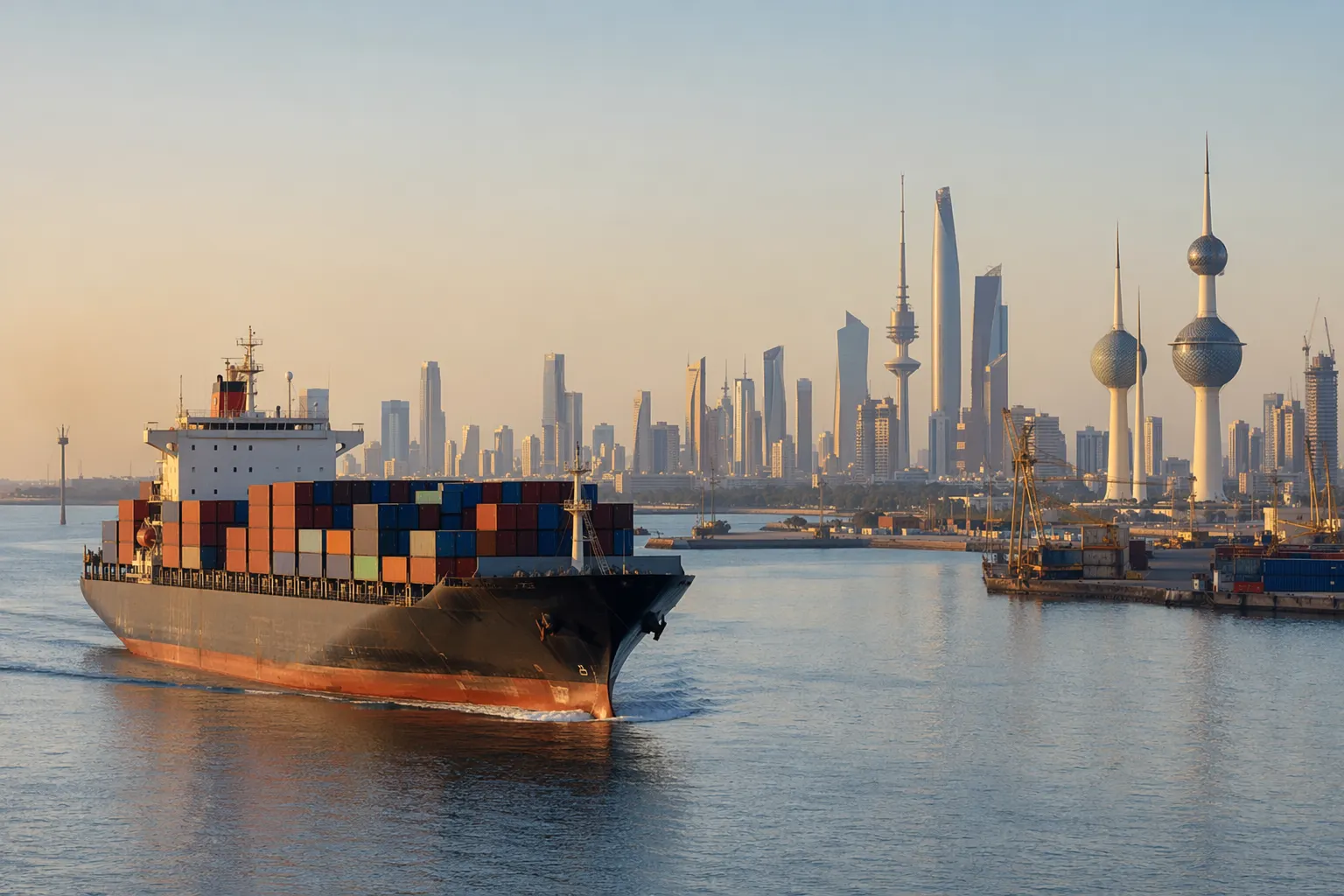
Search for shipping companies from China to Kuwait and every result is a forwarder’s own route page ranking itself first — or an 80-name directory with no methodology, no verdicts and no way to choose. Nobody actually compares providers. This page does, with two things no competitor offers: full disclosure — SINO Shipping is our platform, we rank ourselves #1 and tell you exactly why, alongside five strong alternatives; and a published methodology with honest cons for every company, including us.
One more thing the self-promo pages never explain: “shipping company” on this corridor means three different layers — ocean carriers (COSCO, CMA CGM) that operate the vessels, express integrators (DHL, Aramex) for parcels, and freight forwarders that book the first two and manage everything around them. This list covers all three, because the right pick depends on which layer you actually need. For rates, duties and the KUCAS process, see the full guide to shipping from China to Kuwait — this page is the companies shortlist.
The Top 6 at a Glance
| # | Company | Type | Kuwait routing | DDP door-to-door | Best for |
|---|---|---|---|---|---|
| 1 |  SINO Shipping | Freight forwarder | Direct (COSCO) or feeder — quoted side by side | Yes | Best overall: FCL, LCL, air and consolidation with KUCAS-aware paperwork |
| 2 |  COSCO Shipping | Ocean carrier | Direct calls at Shuwaikh | No (port-to-port) | FCL importers who want the shortest sea transit |
| 3 |  CMA CGM | Ocean carrier | Weekly feeder via Jebel Ali to Shuwaikh and Shuaiba | No (port-to-port) | FCL shippers with their own Kuwaiti clearing agent |
| 4 |  DHL Express | Express integrator | Direct air network to KWI | Duties billed at delivery | Urgent parcels and documents, 3–6 days |
| 5 |  Aramex | Express integrator | Regional network, home turf in the Gulf | Duties billed at delivery | E-commerce parcels needing strong Kuwaiti last-mile |
| 6 |  DDPCHAIN | DDP specialist | Consolidated air and sea | Yes (only model) | Small importers who want one all-in price, zero customs contact |
Quick verdicts by importer profile:
- Best overall + multi-supplier consolidation: SINO Shipping (#1)
- Fastest sea transit for full containers: a forwarder booking COSCO direct (#2)
- Cheapest FCL if you have your own broker: CMA CGM feeder via Jebel Ali (#3)
- Samples and urgent parcels: DHL (#4); budget alternative below
- E-commerce with Kuwaiti home delivery: Aramex (#5)
- Hands-off all-in shipping without touching customs: DDPCHAIN (#6) — read the DDP caveat in its entry
How We Ranked These Companies (Methodology)
No list in this space publishes criteria — one competitor’s “Top 80” doesn’t even rank its 80 names. Here is what we scored, using verifiable public information plus our own operating knowledge of the corridor:
| Criterion | Weight | What we checked |
|---|---|---|
| Kuwait corridor capability | 30% | Regular sailings or flights on the lane, Shuwaikh/Shuaiba routing, KWI air coverage |
| Compliance readiness | 25% | KUCAS/PAI conformity documentation at origin, Arabic paperwork, licensed Kuwaiti clearing partners |
| Pricing transparency | 20% | Published or dated rates, itemised quotes with validity windows, clear DDP scope |
| Fit by shipment size | 15% | Parcel, LCL, FCL and consolidation coverage — no company is best at everything |
| Verifiable track record | 10% | Founding data, port calls, third-party citations — unverifiable claims scored zero |
Not a single competing page mentions KUCAS conformity — Kuwait’s product-certification program that decides whether regulated goods clear or sit at port. That gap alone tells you how much of this SERP is copy-paste. The KUCAS clearance guide covers the process itself; here it’s a ranking criterion. For the general vetting framework behind these weights, see how to choose a freight forwarder in China.
1. SINO Shipping — Best Overall for China–Kuwait Freight
Type: Freight forwarder, HQ Hong Kong | Modes: Sea (FCL/LCL), air, express | DDP: Yes | Best for: Importers who want one accountable partner from Chinese factory to Kuwaiti door
Full disclosure, again: this is us. So instead of adjectives, here is what a real quote from our team looks like on a Gulf-bound container — because the mechanics are the pitch. Our operations team prices the same box two ways: a COSCO sailing against a CMA CGM alternative, each with an explicit validity date, an insurance line, and a peak-season warning when rates are about to move. If you already have your own clearing agent at destination, we quote DAP and hand over cleanly; if not, we run delivery through vetted local partners. That two-routing, dated-quote format is exactly what this corridor needs, given the direct-vs-feeder spread explained below.
The other differentiator is paperwork at origin. Kuwait-bound cargo lives or dies on documents prepared before the vessel sails — KUCAS conformity certificates for regulated goods, correctly consularised commercial invoices, ISPM-15 pallets. With teams across Hong Kong, Shenzhen, Guangzhou, Shanghai, Ningbo, Tianjin and Qingdao, the person handling your booking sits in the same city as your supplier, which is where China–Kuwait shipments actually go wrong. Our Kuwait lane rates are re-checked and republished monthly in the country guide, stamped with the month — you can sanity-check our quote against our own public numbers.
Pros:
- Quotes direct (COSCO) and feeder (CMA CGM via Jebel Ali) routings side by side, with validity dates — most forwarders quote one and hide the trade-off
- Offices in all major Chinese origin ports: pickup, consolidation and export clearance in-house at origin
- KUCAS-aware documentation prep before sailing; DAP option if you have your own Kuwaiti broker
- Full range on one quote: FCL, LCL, air and express — and we regularly tell sub-100 kg shippers to use a courier instead, because it’s cheaper for them
- Monthly published Kuwait rate benchmarks, dated
Cons:
- No owned office in Kuwait — destination clearance and delivery run through licensed local clearing partners, not SINO-badged staff
- Not the cheapest for single small parcels (the express tier below wins there)
- Kuwait is a mid-size lane for us — Gulf neighbours like the UAE and Saudi Arabia see higher volume
Want to test us? Request a China–Kuwait quote and count how many routings come back.
2. COSCO Shipping — The Direct-Call Carrier
Type: Ocean carrier, state-owned, HQ Shanghai | Modes: Sea FCL (LCL via forwarders) | DDP: No — port-to-port | Best for: Regular FCL importers who want the shortest sea transit to Shuwaikh
Here is the single most useful fact on this corridor, and no ranking page explains it: COSCO’s Middle East network includes direct calls at Shuwaikh — one of the very few direct China–Kuwait carrier options. Everyone else’s container mostly rides a mainline vessel to Jebel Ali, waits for a weekly feeder, and arrives days later. When a forwarder quotes you a suspiciously short transit, they’ve booked COSCO direct; when the quote is cheaper but slower, it’s a feeder routing. Same destination, different products.
Booking COSCO directly is realistic only for a specific profile: regular full containers, your own export documentation, and a licensed clearing agent in Kuwait — carriers sell vessel slots, not consolidation, KUCAS files or trucking to Ahmadi. Most importers access COSCO’s direct sailings through a forwarder instead, which is also how LCL cargo gets aboard. Our list of the top sea freight forwarders in China covers who books these vessels well.
Pros:
- Direct Shuwaikh calls — shortest sea transit available on the corridor
- Massive China port coverage; sailings from every major origin
- State-owned giant: schedule reliability and equipment availability in peak season
Cons:
- Port-to-port only: no pickup, consolidation, Kuwaiti clearance or delivery
- Direct booking suits high-volume shippers; small importers get better terms via forwarders
- FCL-first — LCL to Kuwait goes through consolidators anyway
3. CMA CGM — The Feeder Workhorse with a Kuwait Office
Type: Ocean carrier, HQ Marseille | Modes: Sea FCL (LCL via forwarders) | DDP: No — port-to-port | Best for: FCL shippers optimising cost over speed, with destination handling already solved
CMA CGM is the pattern that explains most of Kuwait’s transit-time variance: it serves Shuwaikh and Shuaiba via weekly feeder from Jebel Ali rather than direct calls, and it maintains a local Kuwait office — rare among majors and genuinely useful when a box needs chasing at destination. Maersk, MSC and Hapag-Lloyd reach Kuwait the same way; we list CMA CGM as the representative pick because of that local presence.
The feeder trade-off is simple: add roughly 5–15 days over a direct sailing, depending on the Jebel Ali connection — and often subtract real money. In our own quoting, the CMA CGM option is frequently the value play when the delivery window allows it. If you’re weighing container options, our guide to FCL vs LCL sea freight to Kuwait covers where each makes sense.
Pros:
- Weekly feeder coverage to both Shuwaikh and Shuaiba — Kuwait’s two main container gateways
- Local Kuwait office for destination-side issues
- Often the cheaper FCL routing when transit time is flexible
Cons:
- Transshipment via Jebel Ali adds 5–15 days and one more place for delays
- Port-to-port only; everything around the vessel is on you or your forwarder
- Feeder schedules are the first to slip in peak season
4. DHL Express — Fastest Door-to-Door for Parcels
Type: Express integrator | Modes: Air express | Best for: Samples, documents and urgent parcels under ~100 kg
DHL is named on every page ranking for this query, and for the parcel tier it earns it: 3–6 days door-to-door from China to Kuwait, full tracking, and customs brokerage built into the product. The price anchor worth knowing: a 5 kg parcel runs about $214 — versus roughly $110 on FedEx’s slower International Priority (5–8 days) and about $54 with a budget consolidator that takes 10–20 days. You’re buying speed and certainty, not economy.
The maths flips fast with weight: above roughly 100 kg, express pricing turns punitive and forwarder-booked air freight takes over. Our DHL from China review covers coverage and surcharges in detail, and the best express couriers from China comparison ranks the whole tier.
Pros:
- Fastest reliable option on the corridor: 3–6 days door-to-door to Kuwait
- Customs brokerage included; duties billed transparently at delivery
- Best-in-class tracking and claims process
Cons:
- Premium pricing — roughly 4x a budget consolidator on a 5 kg parcel
- Uneconomic above ~100 kg versus air freight
- Remote-area surcharges apply outside Kuwait City and Ahmadi
5. Aramex — The Gulf’s Home-Turf Integrator
Type: Express integrator, HQ Dubai | Modes: Air express, e-commerce logistics | Best for: E-commerce parcels where Kuwaiti last-mile quality decides customer satisfaction
Aramex is the only Middle East-headquartered integrator serving this corridor — and the only company that appears both as a courier partner on China-side DDP platforms and in directories of forwarders physically operating in Kuwait. That double presence is the point: DHL flies parcels to Kuwait; Aramex also lives there, with the local delivery network, Arabic-speaking support and address-system fluency that decide whether an e-commerce customer in Salmiya actually receives the package.
For Chinese-origin parcels it’s typically a notch cheaper than DHL and a notch slower, which is exactly the right trade for non-urgent e-commerce restocks.
Pros:
- Strongest last-mile network in Kuwait of any company on this list
- Regional HQ means Gulf-native customs handling and support
- Well-priced middle ground between DHL’s speed and consolidators’ economy
Cons:
- Slower than DHL on the China–Kuwait leg
- Parcel and e-commerce focus — not the answer for pallets or containers
- China-side pickup coverage thinner than the global integrators’
6. DDPCHAIN — DDP Specialist with the Most Transparent Pricing
Type: China-based DDP forwarder | Modes: Consolidated air and sea, DDP only | Best for: Small importers who want one all-in price and zero contact with customs
Credit where due: DDPCHAIN publishes the most transparent corridor pricing of any company ranking for this query — dated figures, weight-bracketed air rates showing economies of scale, and all-in DDP products around 5–9 days by air and 30–45 days by consolidated sea. For a first-time importer who never wants to see a customs form, one price to the door with duty inside is a genuinely useful product.
Two honest flags. First, its published guide names no ocean carriers and contains zero Kuwait compliance detail — no KUCAS, no duty rates — so treat it as a parcel-and-pallet consolidator, not a full-corridor forwarder. Second, all-in DDP bundles freight, clearance and duty into one number, which is convenient but unauditable — and on this corridor the importer-of-record question matters. Read our DDP shipping to Kuwait guide before booking DDP with anyone, including us.
Pros:
- Most transparent published rates in the niche — dated, bracketed, realistic
- True all-in DDP: consolidation, freight, clearance and duty in one price
- Good fit for multi-supplier e-commerce loads too big for couriers, too small for FCL
Cons:
- Zero published compliance capability — regulated (KUCAS-scope) goods are the wrong cargo for this model
- Bundled pricing is hard to audit line by line; always ask who acts as importer of record
- Consolidated sea at 30–45 days is the slowest option on this list
Also worth knowing (honourable mentions): Winsky Freight (Shenzhen, air-and-courier consolidation; quotes 5–8 days air and 21–34 days sea to Kuwait — but its Kuwait page carries incorrect customs figures, so verify duty claims independently), Basenton Logistics (publishes the most granular origin-port transit matrix on the corridor, Shenzhen 21 days through Tianjin 39 days), DocShipper (sourcing-QC-freight bundle with solid port data), and CFC (Hong Kong-registered, one of the few sources covering MOCI import licensing and Arabic labelling). All are real corridor players; they missed the top 6 on Kuwait-specific capability, accuracy or breadth — not legitimacy.
Carrier, Courier or Forwarder: Which Layer Should You Book?
The fastest way to overpay on this corridor is booking the wrong layer. The decision tree is short:
- Under ~100 kg: express tier. DHL for urgency, Aramex for Kuwaiti delivery quality, a DDP consolidator for price. No forwarder beats integrators here once minimum charges count.
- ~100 kg to a few CBM: forwarder territory — consolidated air or LCL sea, with KUCAS paperwork handled at origin. This is where multi-supplier consolidation starts paying for itself.
- Full containers: a forwarder booking carrier space — COSCO direct when the deadline is tight, Jebel Ali feeder when cost wins. Book the carrier yourself only with in-house export docs and your own Kuwaiti clearing agent.
- Regulated goods (electronics, appliances, toys, building materials): whoever you pick must answer one question convincingly — who prepares the KUCAS conformity file, and when? If the answer is vague, the cargo waits at Shuwaikh. Mode choice details are in how to choose the right shipping mode for Kuwait.
How to Vet Any China–Kuwait Shipping Company Before Paying
Kuwait adds two verification steps to the standard checklist — no competing list mentions either:
- Ask who clears in Kuwait. Final clearance runs through a licensed Kuwaiti clearing agent. A legitimate forwarder names its destination partner or quotes DAP for your own broker; a vague “we handle everything” is a red flag.
- Ask when KUCAS documents get prepared. For regulated goods, conformity paperwork happens at origin, before sailing. A company that discovers KUCAS after booking will cost you weeks at port.
- Demand an itemised, dated quote. Freight, origin charges, destination charges and any duty line separated — with a validity date. Real spot quotes expire; evergreen prices are bait.
- Verify the company itself. Chinese business licence, freight registration, named contacts, verifiable founding date. In this SERP we found competing lists disagreeing on basic company facts without citing sources — check, don’t trust.
- Watch payment discipline. Deposits are normal; 100% upfront by wire to a new counterparty is how importers get burned. A rate 40% below the market bands isn’t a bargain — it’s a scope cut or a customs problem you haven’t met yet.
The full framework — contract clauses, insurance, red-flag phrases — is in our forwarder red flags guide, and duty-side homework starts with Kuwait import duties and taxes.
Bottom Line
Match the company to the layer and the load: a forwarder booking COSCO direct when transit matters, the CMA CGM feeder when cost wins, DHL or Aramex below 100 kg, DDPCHAIN for hands-off all-in parcels and pallets — and for everything that needs consolidation, KUCAS-ready paperwork and both routings priced honestly on one page, get a China–Kuwait quote from SINO Shipping and check the validity date on what comes back.
ReferenceGlossary· 24 terms
Search a term, or jump by letter.
- all-in
- Quote that includes the main cost components (e.g. freight + handling + clearance). Always confirm what's included so you're not comparing a partial quote to a full one.
- brokerage
- Fee for customs brokerage: filing the declaration, liaising with customs, and securing release. May be bundled (e.g. express) or separate.
- CBM
- Cubic metre. Standard unit for shipping volume; used for LCL pricing and container capacity.
- clearance
- Customs clearance. Process of presenting goods and documents to customs and obtaining release for import or export. Export clearance (who files it) is the key difference between EXW and FOB.
- consolidation
- Combining several LCL shipments into one container at origin. Reduces cost per CBM; adds CFS time.
- DAP
- Delivered At Place. Seller delivers to a named place (e.g. buyer's warehouse) and unloads; buyer handles import clearance, duties, and Consumption Tax. IOR is the buyer.
- DDP
- Delivered Duty Paid. Seller pays all costs to the buyer's door, including clearance, duties, and Consumption Tax. True DDP means the recipient pays nothing at delivery.
- destination charges
- Fees at the destination port: terminal handling, documentation, release, CFS deconsolidation (LCL), storage. Often bundled or omitted from the first quote—confirm line by line.
- door-to-door
- Service from shipper's door to consignee's door. The forwarder or carrier coordinates all legs, including pickup and delivery.
- duty
- Import duty. Tax levied by customs on imported goods, based on HS code, value, and origin.
- export clearance
- Customs process to release goods for export before departure. Who arranges it depends on Incoterm: seller under FOB/FCA, buyer under EXW.
- FCL
- Full Container Load. You book an entire container (e.g. 20GP or 40HC); only your cargo inside.
- forwarder
- Freight forwarder. Company that books transport, arranges documentation, and often coordinates customs on your behalf.
- Importer of Record
- The entity in the destination country legally responsible for the import declaration and for paying duties and taxes (abbrev. IOR).
- ISPM-15
- International Standards for Phytosanitary Measures No. 15. Treatment standard for wood packaging (e.g. pallets) to prevent pests.
- KUCAS
- Kuwait Conformity Assurance Scheme. Kuwait’s mandatory product certification program for regulated imports, ensuring compliance with national standards.
- last-mile
- Final leg of delivery from port, airport, or warehouse to the consignee's address. May include remote-area or residential surcharges.
- LCL
- Less than Container Load. Your cargo shares a container with others; priced per CBM (plus CFS and handling at both ends).
- origin charges
- Fees at the export port: THC, handling, documentation, CFS (for LCL). Under FOB these can be bundled and opaque; under FCA the split is clearer since the buyer books freight and the seller's scope ends at delivery.
- pickup
- Factory collection. Truck books, loads at origin, and transports cargo to the CFS, CY, or airport. Distance, multi-supplier stops, and cargo readiness affect cost.
- port-to-port
- Service from origin port to destination port only. You (or your forwarder) arrange pickup and delivery separately.
- REACH
- Registration, Evaluation, Authorisation and Restriction of Chemicals (EC 1907/2006). EU regulation controlling chemicals in products imported into Portugal.
- Shuwaikh Port
- Kuwait’s main commercial seaport, handling the majority of containerized and general cargo imports.
- transshipment
- Cargo is transferred at an intermediate port before reaching the final destination. Adds another terminal, cut-off, and handoff—more variability than direct sailings.
No term matches your search.