
In this guide
- Shenzhen / Guangzhou, China → Pennsylvania, USA
- Sea Freight
- Greenery boxwood wreaths with customizable flower/berry additions on bundled real vine bases
- Country guide Shipping from China to United States →
Assuming plastic wreath bases are “always cheaper and easier” can quietly drain margin. In a July sourcing sprint, two near-identical wreath bases quoted side-by-side showed plastic at $2.57 and $4.23 EXW versus real vine at $2.37 and $3.94 EXW. After adding $0.26 per unit for inspection/fumigation on the natural option, one size landed at $2.63 vs $2.57 (plastic ahead by a sliver), while the larger landed at $4.20 vs $4.23 (vine edged it). The only safe rule in 2026: calculate landed unit cost before you lock your bill of materials.
Wreath bases: plastic vs vine price gap is size-dependent
A seasonal-goods importer asked us to dual-track sample and price two styles of greenery wreaths from South China—same finished look, two base materials (PE plastic vs real vine), two base sizes:
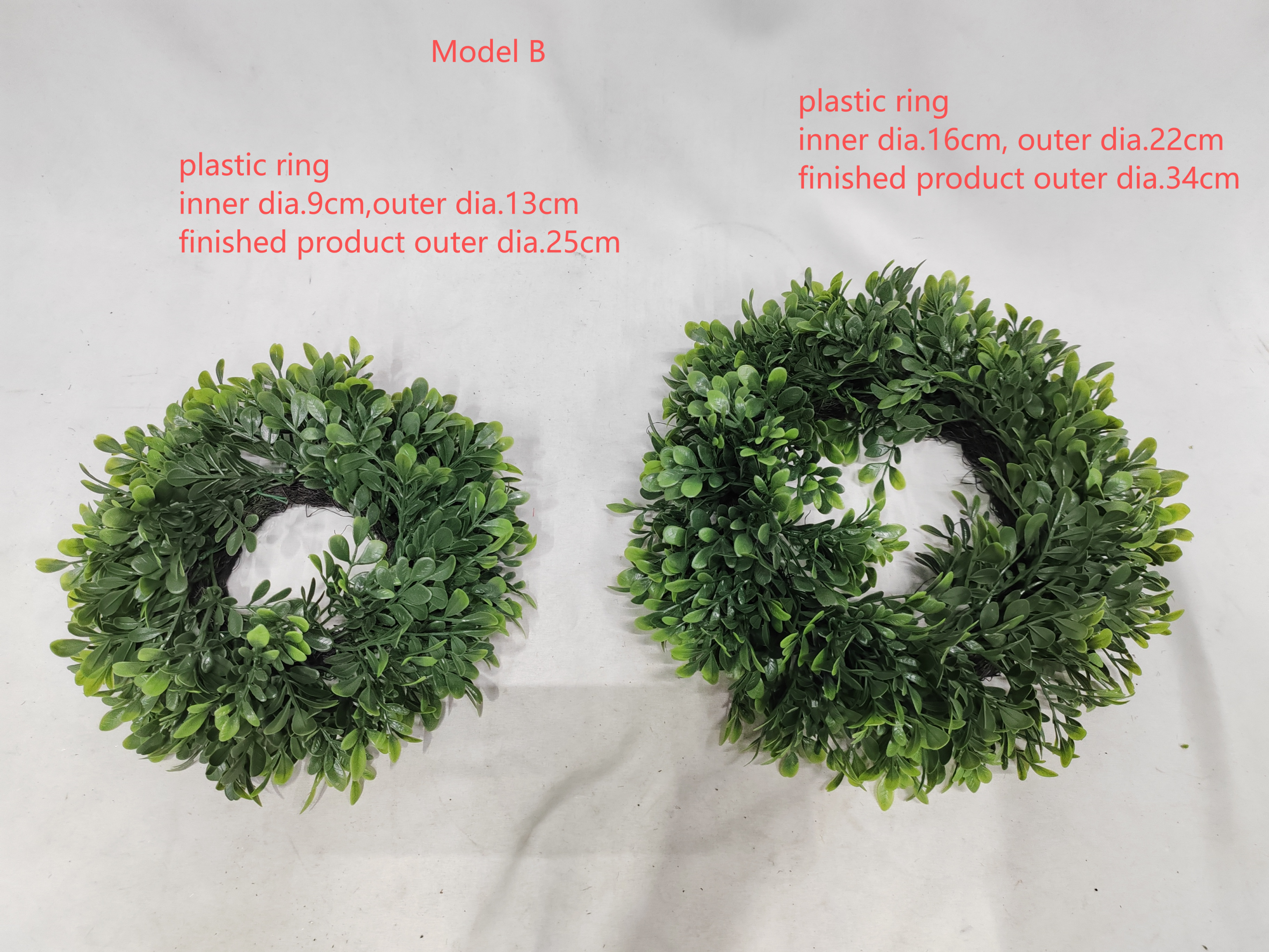
- Style A: base inner/outer 9/13 cm → finished 23 cm
- Style B: base inner/outer 16/22 cm → finished 31 cm
Suppliers quoted EXW for both materials, then we overlaid compliance costs for natural vine: commodity inspection plus fumigation added $0.26 per unit. The result flipped the “plastic = cheaper” assumption depending on size.
Table: Side-by-side EXW and landed unit costs (supplier-quoted, July)
| Style | Base Material | EXW Price (USD) | Compliance Add (USD/pc) | Landed EXW Basis (USD/pc) | Who’s Cheaper | Relative Difference |
|---|---|---|---|---|---|---|
| A (23 cm finished) | PE plastic | 2.57 | 0.00 | 2.57 | Plastic | Plastic is roughly 2% lower |
| A (23 cm finished) | Real vine | 2.37 | 0.26 | 2.63 | ||
| B (31 cm finished) | PE plastic | 4.23 | 0.00 | 4.23 | Real vine | Vine is roughly 1% lower |
| B (31 cm finished) | Real vine | 3.94 | 0.26 | 4.20 |
Why plastic wasn’t automatically cheaper in July 2026
- Polymer inputs were volatile. PE feedstock pricing and small-batch molding runs pushed quotes up on compact sizes where labor and set-up don’t amortize well.
- Real vine had a lower EXW for both sizes. The natural base required phytosanitary steps (inspection + fumigation), but that fixed add neutralized more of the advantage on the smaller size than the larger one.
- Compliance is a fixed-per-unit overlay. The $0.26/pc compliance cost diluted to about one percent of the larger base’s EXW, but a bigger percentage of the smaller unit’s EXW—hence the crossover.
When buying teams ignore compliance overlays, they risk selecting the wrong material by a narrow but meaningful percentage—especially damaging at marketplace scale where fees are stacked on top of COGS.
The repeatable landed-cost method we used (use it on your next brief)
SINO’s on-the-ground sourcing and logistics work together so the costing reflects reality end-to-end. For wreath bases, we ran this simple, audit-ready flow:
-
Lock specifications in writing
- Define inner/outer base diameters and finished diameter (after foliage).
- Confirm base thickness and material tolerance (e.g., 2 cm vine bundle).
- Clarify packaging (OPP bag + box vs OPP only) for cubic efficiency.
-
Dual-track quote request
- Request EXW for both materials from the same supplier where possible to control for workmanship.
- Mandate dimensioned samples for both styles.
-
Overlay compliance and handling
- Natural materials: commodity inspection + fumigation (fixed per unit).
- Packaging certification if needed (e.g., ISPM 15 for wood packaging).
- Pre-shipment inspection scope and per-unit allocation.
-
Add logistics-to-door per unit
- Convert packaging to CBM/carton; compute units per CBM.
- Apply current LCL/FCL ocean to destination and last-mile delivery.
- Include DDP components where applicable (duties/taxes/entry).
Table: Landed unit cost build (template you can reuse)
| Cost Layer | Plastic Base | Real Vine Base | Notes |
|---|---|---|---|
| EXW unit | Supplier EXW | Supplier EXW | From RFQ with locked specs |
| Compliance per unit | Typically nil | +0.26 | Commodity inspection + fumigation for natural |
| Inspection allocation | + per unit | + per unit | Based on agreed AQL/scope |
| Packaging allocation | + per unit | + per unit | Carton/inner/labels |
| Freight to warehouse (China) | + per unit | + per unit | Factory to Shenzhen/Guangzhou consolidation |
| Ocean + destination | + per unit | + per unit | LCL/FCL, DDP if applicable |
| Duties/taxes (if DDP) | + per unit | + per unit | HS code dependent |
| Final door delivery | + per unit | + per unit | Carrier + accessorials |
| Total landed per unit | Sum | Sum | Compare by style/size |
We maintain the routing rules and rate files to keep these layers current. With eight China offices and consolidation warehouses around Shenzhen/Guangzhou, we collect from multi-suppliers, standardize cartons, and put one landed unit number in front of you—before you commit your BOM.
What changed the decision for the importer
Friction we solved:
- Assumption risk: The buyer believed PE would be cheaper and easier; locking BOM early would have cost margin on the larger SKU.
- Spec drift: Early discussions mixed base diameter with finished diameter; we froze both to avoid quoting apples-to-oranges.
- Compliance blind spot: Natural vine needs commodity inspection and fumigation; we priced it per unit and showed the percentage impact by size.
What made the outcome credible:
- Same-week sampling: Two styles, both materials, measured A/B.
- Size-true pricing: Inner/outer diameters confirmed on samples (9/13 cm → 23 cm finished; 16/22 cm → 31 cm finished).
- Export-ready costing: The $0.26/pc compliance add was not a guess; it reflected actual supplier and CIQ steps for that export month.
Net result:
- Style A: plastic ahead by roughly two percent on the landed EXW basis.
- Style B: vine ahead by roughly one percent on the landed EXW basis.
For a marketplace seller, a one to two percent unit-cost swing compounds through referral fees, ad spend, and returns. Choosing wrong at the BOM stage magnifies the mistake every time you reorder.
How to avoid the “plastic-cheaper” trap on your next wreath run
- Specify like a factory: Give inner/outer base diameters, finished diameter, and base thickness in centimeters. Provide pack-out (units/carton, carton dims).
- Quote both materials, same spec, same week: Don’t compare a May vine quote to an August plastic quote; polymers move.
- Add fixed-per-unit compliance first: For natural materials, treat inspection/fumigation as part of EXW. Then add inspection and logistics.
- Model both LCL and FCL: Larger SKUs are often padding-heavy; CBM efficiency can reverse the winner once ocean is included.
- Keep an “AQL tax” line: If one material needs tighter QC (surface defects, cracks), raise inspection scope and allocate its true per-unit cost.
Table: Quick decision matrix (when plastic vs vine tends to win)
| Scenario | Likely Winner | Why |
|---|---|---|
| Smaller base, tight pack-out, high compliance add | Plastic | Compliance is a larger percent of EXW on small SKUs |
| Larger base, good CBM efficiency, stable vine supply | Real vine | Compliance becomes a lower percent; vine EXW advantage holds |
| Polymer surge month, short lead time | Real vine | PE quotes jump; vine less volatile in some clusters |
| Heavy sustainability messaging, premium positioning | Real vine | Perceived value supports slight cost uplift; better sell-through |
Why SINO’s math holds up in production
Since 1989, SINO Shipping has operated as a Class A / NVOCC forwarder with eight offices in China and consolidation hubs across Shenzhen and Guangzhou. We source, verify, inspect, and ship under one roof, so your landed-cost worksheet isn’t a spreadsheet guess—it’s a live operations plan:
- Supplier vetting with sampling and photo/video verification
- Pre-shipment inspections to your AQL
- Commodity inspection and fumigation scheduling for naturals
- Consolidation from multiple factories into one shipment
- Sea, air, rail, express, customs, and DDP to Europe and LATAM (and beyond)
- FBA prep and labeling where needed
That’s why our percentage deltas match what actually lands at your door.
Conclusion: Treat wreath bases as a landed-cost decision, not a material choice
The July A/B proved it: for wreath bases, plastic can be roughly two percent cheaper on one size and real vine roughly one percent cheaper on another—even after you price inspection and fumigation. In 2026, polymer volatility, sustainability preferences, and fixed compliance overlays mean the only reliable rule is to compute landed unit cost and pick the winner by style. SINO’s combined sourcing and logistics footprint in China makes that math fast and defensible.
If you want this analysis done on your next SKU brief—specs locked, samples compared, compliance priced, and door-delivered—ask SINO Shipping for a landed-cost quote.
'Thank you for all the help you guys have been providing.'
ReferenceGlossary· 12 terms
Search a term, or jump by letter.
- CBM
- Cubic metre. Standard unit for shipping volume; used for LCL pricing and container capacity.
- consolidation
- Combining several LCL shipments into one container at origin. Reduces cost per CBM; adds CFS time.
- DDP
- Delivered Duty Paid. Seller pays all costs to the buyer's door, including clearance, duties, and Consumption Tax. True DDP means the recipient pays nothing at delivery.
- EXW
- Ex Works. Seller makes goods available at their premises; buyer arranges pickup, export clearance, freight, and everything beyond. Risk transfers at the factory gate—the earliest of all Incoterms.
- FCL
- Full Container Load. You book an entire container (e.g. 20GP or 40HC); only your cargo inside.
- forwarder
- Freight forwarder. Company that books transport, arranges documentation, and often coordinates customs on your behalf.
- HS Code
- Harmonized System code. International product classification used for customs; determines duty rate and any restrictions.
- ISPM 15
- International Standards for Phytosanitary Measures No. 15. Treatment standard for wood packaging (pallets, crates)—heat treatment or fumigation mark required. Non-compliant wood blocks Japan import release.
- last-mile
- Final leg of delivery from port, airport, or warehouse to the consignee's address. May include remote-area or residential surcharges.
- LCL
- Less than Container Load. Your cargo shares a container with others; priced per CBM (plus CFS and handling at both ends).
- RFQ
- Request for Quote. Document you send to forwarders to get rates. Include Incoterm, ports, volume, and request a line-by-line breakdown to avoid hidden fees.
- SKU
- Stock Keeping Unit. Unique identifier for a product variant. Must match across carton labels, packing list, and invoice; mismatches cause warehouse holds or rework.
No term matches your search.