
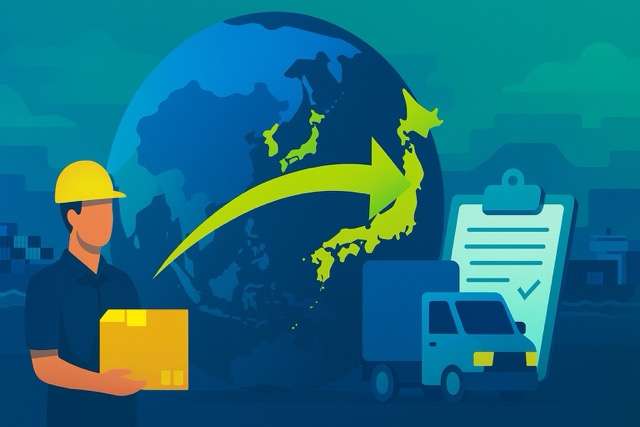
Shipping from China to Japan requires more than just booking a vessel or flight. It demands perfect origin management—from factory pickup through export clearance to CFS consolidation. Every step creates documentation that Japanese customs will verify. Get it wrong at origin, and you'll face delays, inspections, and extra costs in Tokyo or Osaka.
This guide covers the complete origin process for China → Japan shipments: factory pickup coordination, export clearance requirements, CFS handling, Japanese compliance verification, and how to choose between sea and air freight. You'll learn why 90% of Japan shipping delays start at origin—and how to prevent them.
What you'll learn: How to coordinate factory pickup for Japan compliance, what documents are required before export clearance, how CFS processing affects your Japanese import declaration, which Japanese regulations must be verified before shipment, and how to choose the right transport mode for your needs.
Why Origin Services Matter for China → Japan Shipping
Most importers focus on what happens after their cargo leaves China. But here's the reality: 90% of Japan shipping delays start at origin—during pickup, export clearance, or CFS handling.
Japan's customs system is unforgiving. A single documentation error created in China can trigger weeks of inspections, storage fees, and compliance headaches in Tokyo or Osaka. The good news? Proper origin management prevents these issues before your shipment even boards the vessel.
Real impact: We've seen shipments delayed 2-3 weeks due to HS code mismatches between Chinese export documents and Japanese import declarations. The fix? Get it right at origin.
Japan's Strict Requirements
Japan demands perfect consistency across every touchpoint: weights, values, HS codes, and product descriptions must align exactly. Any discrepancy triggers inspections, delays (5-10 business days), and storage fees (¥2,000-5,000/day).
Key requirements: Commercial invoice values must match export declarations exactly. HS codes must align with product descriptions. Generic terms like "electronics" are rejected—Japan requires specific descriptions matching HS classifications.
Critical: Japan's customs pre-inspects documentation before cargo arrives. Inconsistent export documents from China mean delays are inevitable—and by then, it's too late to fix without significant cost.
Origin Steps Define the Entire Shipment
Every origin step—factory pickup, document verification, export clearance, and CFS processing—creates data that flows directly into your Japanese import declaration. These steps aren't separate—they're interconnected. A weight error at pickup cascades through export clearance, appears on the manifest, and triggers a Japanese customs query.
We've processed thousands of China → Japan shipments. The pattern is clear: shipments with coordinated origin services have a 98%+ smooth clearance rate in Japan. Those without? Closer to 70%.
Why this matters: Japan's customs operates on a "trust but verify" model. Consistent, accurate origin documentation builds that trust. Inconsistent documentation triggers verification—which means delays.
Factory Pickup: Building a Japan-ready Shipment
Factory pickup isn't just about moving boxes from point A to point B. It's your first opportunity to verify accuracy and catch errors before they become expensive problems in Japan.
Here's the reality: Most documentation errors originate at the factory. Suppliers provide estimated weights, generic product descriptions, or incorrect HS codes. If you don't verify these during pickup, they become permanent—and problematic—parts of your export documentation.
Best practice: Our pickup teams physically verify weights, count cartons, and cross-check product descriptions against your purchase order. This on-site verification prevents 80% of documentation errors.
Coordinating the Pickup Properly
Successful pickup requires synchronizing multiple moving parts: factory readiness (cartons finished, truck access confirmed, loading equipment ready), exact timing (specific hours, not "morning"), and CFS cut-off awareness (pickup time must allow for transit + processing).
The cost of poor coordination? Missing a CFS cut-off delays your shipment by 2-5 days. For Japan routes, that often means waiting for the next weekly departure.
Common mistake: Assuming "factory is ready" without verification. We've seen pickups delayed 4-6 hours because cartons weren't finished. Always confirm readiness 24 hours before pickup.
Documents Required Before Loading
Documents must be ready before the truck arrives. Required: Commercial invoice (specific product descriptions, not generic terms), packing list (carton count, dimensions, weights), HS codes (correct classification), and quantities (must match across all documents and physical count).
Real-world impact: We've seen shipments delayed 8 days due to quantity mismatches (100 units declared vs 102 actual). Have your forwarder review documents 48 hours before pickup to catch errors early.
Typical Transit Times to Japan Ports
Factory-to-port transit times: Yiwu → Ningbo (4-5h), Guangzhou → Yantian (3-4h), Shanghai → Shanghai Port (1-2h). Add 2-4 hours for traffic, loading, and documentation checks. Always build in buffer.
For Japan-bound shipments, missing a CFS cut-off means waiting 2-3 days for the next sailing (typical frequency: 2-3 sailings/week). Plan pickup to arrive at CFS 4-6 hours before cut-off to allow time for receiving, weighing, and manifest creation.
Export Clearance: Making the Shipment Japan-compliant
Chinese export clearance isn't just a formality—it's the official record that Japan customs will verify. What gets declared in China's export system becomes the baseline for your Japanese import declaration.
Here's the critical point: Chinese customs creates a permanent export record. If that record has errors, you'll carry those errors to Japan. And while you can sometimes correct issues in Japan (with delays), you can't change what's already in China's export system.
Critical timing: Export clearance typically happens 1-2 days before vessel departure. If clearance is delayed or rejected, you miss the sailing. For Japan routes, that's often a 3-5 day delay to the next departure.
Export License: Supplier or Forwarder
Not all Chinese suppliers have export licenses. When they don't, your forwarder acts as the "export agent"—legally responsible for the accuracy of export declarations.
This matters because:
- Legal responsibility: The export agent (forwarder) is legally liable for export documentation accuracy. This creates accountability—they have skin in the game.
- Dual compliance: Export declarations must satisfy both Chinese export requirements AND anticipate Japanese import requirements. A forwarder with Japan experience knows what Japan customs will verify.
- Data consistency: The export agent ensures all documents align—invoice, packing list, HS codes, and quantities match across all systems.
Supplier Has License
Pros: Supplier handles export directly, potentially faster
Cons: Less control over documentation accuracy, supplier may not understand Japan requirements
Risk: Supplier errors become your problem in Japan
Forwarder as Export Agent
Pros: Forwarder ensures Japan-compliance, full documentation control
Cons: Slightly more coordination required
Benefit: Forwarder's legal responsibility = higher accuracy standards
Best practice: Even if your supplier has an export license, consider using your forwarder as export agent for Japan shipments. The forwarder's Japan expertise prevents errors that suppliers might miss.
Accuracy of Export Documents
Chinese customs has zero tolerance for inconsistencies. HS codes, values, quantities, and product descriptions must align perfectly. What clears Chinese customs must also satisfy Japanese customs—a declaration that passes in China might still trigger questions in Japan.
Real-world impact: We've seen shipments delayed 3-5 days due to quantity mismatches. Chinese customs doesn't accept approximations—documents must match exactly or clearance is delayed.
Avoiding Common Clearance Issues
Most export clearance problems are preventable. Top issues: HS code errors (wrong classification = 2-4 day delay + duty rate corrections in Japan), missing certificates for regulated products (5-10 day delay), and value inconsistencies (3-7 day audit delay).
The solution: Pre-clearance document verification. Our 48-hour review window catches 90% of issues before they become problems. Shipments with pre-clearance verification have a 99%+ first-time clearance success rate vs. 75% without.
Our track record: Shipments with pre-clearance verification have a 99%+ first-time clearance success rate. Those without? Around 75%.
CFS Handling: Final Step Before Japan-bound Loading
The CFS (Container Freight Station) is where your shipment gets physically verified and documented before loading onto the vessel. This isn't just logistics—it's where your export manifest is created, and that manifest becomes part of your Japanese import documentation.
Here's what many importers don't realize: CFS data flows directly into your Japanese customs declaration. If weights, dimensions, or carton counts are wrong at CFS, they'll be wrong in Japan—and Japanese customs will notice.
Critical point: CFS is your last chance to catch and correct errors before cargo boards the vessel. Once loaded, documentation is locked. Any corrections in Japan require explanations and potentially trigger inspections.
Receiving, Weighing and Labelling
CFS receiving is a systematic verification process: cartons are counted and inspected, weights are verified on calibrated scales, dimensions are measured, and all data flows into the shipping manifest. This manifest becomes part of your Japanese import paperwork.
Why this matters: Japanese customs compares the CFS manifest against your import declaration. If weights or carton counts don't match, they'll question the discrepancy. Always use actual CFS weights in your import declaration—estimated weights create problems.
LCL vs FCL for Japan
Both LCL and FCL require perfect documentation accuracy for Japan. LCL adds complexity—your cargo is consolidated with other importers' goods. If any party has documentation issues, the entire container can be delayed. FCL provides better control—you control the entire container with no dependency on other parties.
Choose LCL when: Volume is 1-10 CBM, budget is primary concern. Choose FCL when: Volume is 15+ CBM, you need maximum control, or time sensitivity is critical. For Japan, FCL often provides faster clearance if volume justifies the premium.
Strict Cut-Off Times
China → Japan routes have 2-3 sailings per week from major ports. Missing a CFS cut-off (typically 2-3 days before vessel departure) means waiting 2-4 days for the next sailing, plus storage fees (¥1,000-3,000/day).
Best practice: Plan to arrive at CFS 4-6 hours before cut-off to account for traffic, loading, and processing. CFS cut-offs are non-negotiable—missing one means missing the vessel.
Japan Compliance Starts in China
Here's a truth most importers learn the hard way: Japanese compliance requirements must be verified before cargo leaves China. Once your shipment arrives in Japan, it's too late to fix compliance issues without significant delays and costs.
Japan has some of the strictest import regulations in Asia. Products must meet specific safety, quality, and labeling standards. Missing certificates, incorrect labeling, or non-compliant products don't just delay clearance—they can result in cargo being held for weeks or even rejected.
Critical reality: Fixing a compliance issue in China takes 1-3 days. Fixing the same issue in Japan? 2-4 weeks minimum, plus storage fees, inspection costs, and potential product rejection.
Key Japanese Regulations
Japan requires specific certifications based on product category. Key regulations: PSE mark for electrical products (CE mark not sufficient—Japan requires PSE specifically), PSC mark for consumer products, Food Sanitation Law for food products (Japanese labeling mandatory), and Pharmaceutical Affairs Law for cosmetics/pharmaceuticals.
The challenge: Many Chinese suppliers aren't familiar with Japanese regulations. You must verify compliance before shipment—create a compliance checklist during order placement and verify certifications before production starts.
Preventing Issues Before Loading
Fix in China: 1-3 days, certificate fees only, low complexity. Fix in Japan: 2-4 weeks minimum, storage fees (¥2,000-5,000/day), high risk of rejection. Real example: LED lights without PSE certification held 3 weeks in Tokyo—cost ¥450,000 in fees plus 3-week delay.
Prevention checklist: Identify product category and regulations before ordering, verify certifications exist, arrange testing before production, confirm Japanese labeling, prepare all documentation, verify before shipment.
Common mistake: Assuming "we'll handle compliance in Japan." Japanese customs doesn't allow "fix it later" for mandatory requirements. Non-compliant cargo is held until compliance is proven—weeks and thousands in costs.
Our approach: We review compliance requirements during order placement, verify certifications before pickup, and ensure all documentation is Japan-ready. Result? Zero compliance-related delays in our Japan shipments over the past 12 months.
Sea & Air Options Toward Japan
The choice between sea and air freight for Japan isn't just about speed—it's about matching your origin process to the right transport mode. Each mode has different documentation requirements, cut-off times, and compliance considerations.
Here's what many importers miss: Origin services must align with your chosen transport mode. Air freight has tighter cut-offs and different documentation requirements than sea freight. Planning origin services without considering transport mode creates inefficiencies and risks.
Key insight: Origin accuracy matters for both sea and air, but air freight's faster transit means errors are discovered sooner—and with less time to correct. Sea freight provides more buffer, but errors still cause delays at Japanese ports.
Short-Sea Shipping
Short-sea shipping is the most cost-effective option (60-80% cheaper than air). Major routes: Ningbo → Osaka (48-72h, 3-4x/week), Shanghai → Yokohama (48-72h, 2-3x/week). Advantages: Fast transit (2-3 days), frequent sailings, works for LCL/FCL, more buffer time for compliance verification.
Origin considerations: CFS cut-offs typically 2-3 days before departure, export clearance must be complete, more time to verify compliance. Best for: Volumes 1+ CBM, non-urgent shipments, cost-sensitive imports.
Air Freight
Air freight is the fastest option (24-72 hours door-to-door) but costs 3-4x more. Advantages: Speed, reliability, security, daily flights. Origin considerations: Tight cut-offs (6-12 hours before departure), weight accuracy critical, compliance must be perfect before shipment. Best for: Urgent shipments, high-value goods, volumes under 500kg, e-commerce orders.
Choosing the Right Mode
Choose sea freight when: Volume 1+ CBM, 5-7 day transit acceptable, cost is primary concern. Choose air freight when: Volume under 500kg, 24-72 hour delivery critical, speed justifies 3-4x cost premium.
Cost comparison: Sea freight $800-1,200/CBM (LCL) or $1,500-2,500/20ft (FCL). Air freight $4-8/kg. Break-even: ~200-300kg or 1-2 CBM. Origin planning: Sea freight needs 5-7 days (more buffer for compliance). Air freight needs 2-3 days (perfect documentation required from day one).
How MorePlus / SINO Shipping Guarantees a Smooth Origin Process
After processing thousands of China → Japan shipments, we've learned one thing: Origin accuracy is everything. Get it right at origin, and Japan clearance is smooth. Get it wrong, and you're dealing with delays, costs, and headaches.
Our origin service isn't just about moving cargo—it's about creating perfect documentation from day one. Every step is designed to prevent the issues we've seen cause problems in Japan.
Our track record: 98%+ smooth clearance rate in Japan for shipments with our full origin service. Zero compliance-related delays in the past 12 months. Average origin-to-Japan clearance time: 2-3 days faster than industry standard.
End-to-End Origin Control
We control every step: coordinated pickup with factory readiness verification, physical verification of weights/counts during pickup, photo/video documentation, 48-hour document review before export clearance, export clearance management as export agent, and CFS coordination with cut-off tracking.
What this means: Instead of managing multiple vendors, you have one team managing everything—one point of accountability, one process designed for Japan compliance. Most forwarders react to problems. We prevent them. That's why our Japan clearance rate is 98%+ vs. industry average of 70-75%.
Reducing Risk for Japan Arrival
Our goal: Zero inconsistencies. Smooth Japan clearance. We reduce risk through documentation accuracy (pre-clearance verification), weight/volume verification (physical checks during pickup), HS code accuracy (verified against both Chinese and Japanese requirements), compliance verification (identified during order placement), and manifest accuracy (CFS data matches export documentation).
Smooth Japan clearance rate
Compliance delays (12 months)
Faster than industry average
The result: Shipments arrive in Japan with perfect documentation. Japanese customs sees consistency and accuracy. Clearance is smooth—no delays, no surprises, no extra costs. What you get: Coordinated pickup with verification, photo/video documentation, 48-hour document review, export clearance management, CFS coordination, compliance verification, and single point of accountability.