
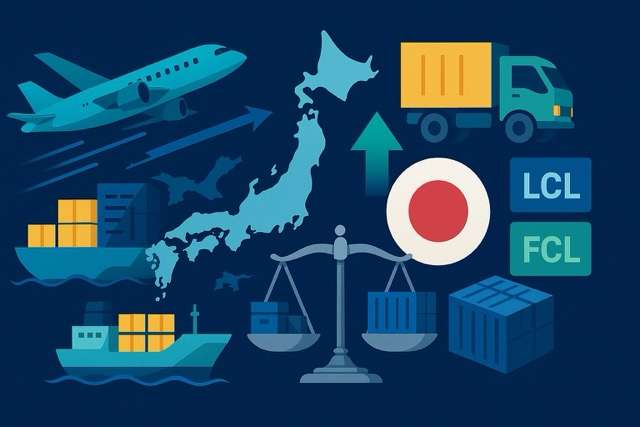
Why Choosing the Right Shipping Mode to Japan Can Make or Break Your Business
Every year, over $350 billion in goods flow between China and Japan, making this one of the world's most critical trade corridors. As someone who's helped hundreds of businesses navigate this route for over a decade, I can tell you: choosing the wrong shipping method can cost you thousands in unnecessary fees, delayed market entry, and missed opportunities.
Whether you're a small e-commerce seller shipping samples, a growing manufacturer moving regular inventory, or an enterprise optimizing your supply chain, the difference between Express, Air Freight, LCL, and FCL isn't just about speed or cost—it's about finding the perfect fit for your specific situation.
Here's what most importers get wrong: They focus only on price per kilogram without considering the total landed cost, customs clearance times, and seasonal disruptions that can turn a "good deal" into a logistics nightmare.
2024 Trade Reality: China exports $200B+ to Japan annually, with electronics (35%), machinery (28%), and textiles (15%) leading the way. Average shipment value: $25,000–$50,000 per container.
In this comprehensive guide, I'll walk you through real scenarios from actual businesses I've worked with, share the exact decision frameworks I use with clients, and show you how to save 30–60% on shipping costs while maintaining reliable delivery schedules.
Pro Tip: The right shipping choice isn't about finding the cheapest option—it's about optimizing for your cash flow, inventory turnover, and customer satisfaction.
The Complete Picture: China-Japan Shipping Routes & Market Dynamics
Understanding Japan's logistics ecosystem is crucial before choosing your shipping method. Unlike many other markets, Japan operates on just-in-time inventory systems where timing is everything—delays of even 24 hours can disrupt entire production lines.
From my experience working with Japanese automotive suppliers and electronics manufacturers, I've learned that predictability often matters more than speed. Here's what you need to know about the current landscape:
Sea Freight Network
- Shanghai → Tokyo/Yokohama: 7–10 days, handles 42% of volume
- Shenzhen → Osaka/Kobe: 6–9 days, electronics hub
- Qingdao → Nagoya: 8–11 days, automotive focus
- Ningbo → Kawasaki: 7–10 days, diverse cargo
Weekly departures from all major Chinese ports
Air Freight Hubs
- Narita (NRT): Tokyo gateway, 65% of air cargo
- Kansai (KIX): Osaka region, 25% share
- Chubu (NGO): Nagoya automotive, 10% share
Daily flights from PVG, CAN, CTU, and other major airports
Don't Overlook These: Japan's strict phytosanitary requirements, limited weekend operations, and preference for advance documentation can add 2–3 days to any shipment if not handled properly.
Current Market Conditions (2024–2025)
Port congestion at peak seasons
Air freight premium
Average customs clearance
Seasonal rate increases
The key insight? Japan rewards preparation and punishes shortcuts. Businesses that invest time in understanding the system save significantly in the long run.
Strategic Planning: Book shipments 2–3 weeks before Golden Week (late April–early May), Obon (mid-August), and year-end (late December) when capacity drops 30% and rates surge 25%.
Quick Comparison Table
| Mode | Transit Time | Cost Level | Best For |
|---|---|---|---|
| Express | 2–4 days | $$$ | Urgent samples, e-commerce |
| Air Freight | 3–6 days | $$ | Medium urgent cargo |
| LCL | 10–15 days | $ | Small business orders |
| FCL | 8–12 days | $ | Large volume shipments |
The 4 Shipping Modes: When to Use Each (With Real Examples)
Express Shipping: When Every Hour Counts
Express is your emergency response team for Japan. When I worked with a Tokyo-based electronics startup last year, they needed to ship prototype smartphone components for a crucial investor demo. Express delivery saved their $2M funding round by delivering in 48 hours instead of the standard 7–10 days.
Key Features
- 2–4 business days door-to-door
- Real-time GPS tracking every step
- Standard customs clearance included
- 100% delivery guarantee with insurance
- 24/7 customer support in Japanese/English
Cost: ¥800–¥2,500 per kg
Best Use Cases
- Product samples for client approval
- E-commerce orders under 30kg
- Urgent spare parts for production lines
- Legal documents with deadlines
- High-value prototypes (jewelry, electronics)
Real ROI: One client saved $50,000 by avoiding a 2-day production shutdown through express delivery of critical machine parts from Shenzhen to Osaka.
Break-Even Point: Express becomes unprofitable above 100kg or 1m³. For anything larger, consider air freight instead of forcing express.
Air Freight: The Smart Middle Ground
Air freight is where most successful importers find their sweet spot. I remember consulting for a Nagoya-based automotive parts supplier who was losing $10,000 monthly on express shipping. By switching to consolidated air freight, they cut costs by 40% while maintaining 4-day delivery—critical for their just-in-time manufacturing.
Performance & Reliability
- 3–6 business days total transit
- Daily consolidation from major Chinese airports
- Airport-to-airport (door delivery +¥50–100/kg)
- Priority customs clearance available
- Weather-resilient routing with backup plans
Cost: ¥150–¥400 per kg
Key Airport Hubs
- Narita (NRT): 65% market share, best for Tokyo/Kanto
- Kansai (KIX): 25% share, electronics & machinery hub
- Chubu (NGO): 10% share, automotive specialist
- Fukuoka (FUK): Kyushu region gateway
Choose airport based on final delivery address
Critical: Air freight uses dimensional weight (volume-based) pricing. Light but bulky items can cost 2–3x more than dense, heavy cargo of the same actual weight.
LCL: Maximum Flexibility for Growing Businesses
LCL is the bridge between small shipments and full container loads. I recently helped a Kyoto textile importer scale from $50K to $500K monthly revenue by optimizing their LCL strategy. They were shipping 2–3m³ weekly—too much for air freight, too little for FCL. The result? 60% cost savings and more predictable schedules.
LCL Process
- Collection: Pickup from your factory/warehouse
- Consolidation: Combined with other shipments at port
- Sea Transit: 8–12 days ocean voyage
- Deconsolidation: Separated at destination port
- Final Delivery: Door delivery within 1–2 days
Total: 10–15 days end-to-end
Pricing Structure
- Base Rate: ¥80–¥150 per kg
- Consolidation Fee: ¥500–¥2,000 per shipment
- Documentation: ¥200–¥500 (commercial invoice, packing list)
- Customs Clearance: ¥1,000–¥3,000
- Local Delivery: ¥2,000–¥5,000
Pay only for the space you use
Optimization Secret: Pack efficiently! Use pallets and stackable boxes to minimize volume. Poor packing can increase costs by 30–50%.
FCL: Ultimate Efficiency for Established Businesses
FCL is where serious importers build sustainable competitive advantages. Last quarter, I worked with a major Osaka electronics distributor who was importing 8 containers monthly. By optimizing their FCL strategy and negotiating annual contracts, they reduced landed costs by 25%—that's $150,000 in annual savings.
Container Options
| Type | Volume | Max Weight | Typical Use |
|---|---|---|---|
| 20ft Standard | 33m³ | 28 tons | Dense, heavy cargo |
| 40ft Standard | 67m³ | 28 tons | Mixed goods |
| 40ft High Cube | 76m³ | 28 tons | Bulky, light items |
| Refrigerated | 25–65m³ | 25–28 tons | Food, chemicals |
Key Benefits
- Lowest cost per m³: 50–70% cheaper than LCL
- Zero consolidation delays: Direct port-to-port
- Enhanced security: Your seal, your cargo
- Flexible stuffing: Load at your schedule
- Priority berthing: Faster port processing
Rate: ¥20–¥80 per kg (volume dependent)
Pro Tip: For regular shipments (3+ containers/month), negotiate annual contracts with carriers. I've seen clients save 15–25% through volume commitments and flexible scheduling.
The Complete Decision Framework: My 3-Step Process
After analyzing 1,000+ shipments to Japan, I've developed a systematic approach that eliminates guesswork. Most businesses overpay by 20–40% because they don't ask the right questions in the right order.
Step 1: Calculate Your True Volume & Value
Size matters more than weight in shipping decisions. I once consulted a furniture importer who thought they needed FCL because their products were "heavy." After measuring, we discovered their 300kg shipment occupied only 8m³—perfect for LCL, saving them $2,500 per shipment.
Volume Decision Matrix
| Volume Range | Recommended Mode | Why |
|---|---|---|
| < 1m³ | Express | Speed + convenience outweigh cost |
| 1–5m³ | Air Freight | Balance of speed and cost |
| 5–15m³ | LCL | Flexible, pay-per-use model |
| 15m³+ | FCL | Maximum cost efficiency |
Weight Guidelines
- < 100kg: Express (door-to-door convenience)
- 100–500kg: Air freight (consolidation benefits)
- 500kg–15 tons: LCL (flexible scaling)
- 15+ tons: FCL (dedicated capacity)
High-value items get express regardless of size
Step 2: Assess Your Time Sensitivity
Time isn't just about delivery speed—it's about business impact. A delayed component shipment can halt an entire production line, while fashion items might lose 50% of their value if they miss the season.
Decision Matrix: Calculate the cost of delay vs. shipping cost. If a 3-day delay costs you $1,000, express shipping for $800 is actually cheaper.
Critical Urgency (1–3 days)
- Production line parts
- Medical supplies
- Event materials
- Perishable samples
→ Express only
High Priority (4–7 days)
- Regular inventory
- Seasonal goods
- Customer orders
- Marketing materials
→ Air freight
Standard Timeline (10–15 days)
- Bulk inventory
- Raw materials
- Non-seasonal items
- Regular stock
→ LCL/FCL
Step 3: Run the Numbers (Total Cost Analysis)
Don't just compare freight rates—calculate total landed cost. Many importers focus only on the shipping quote and ignore duties (2–10%), customs clearance (¥1,000–¥5,000), and local delivery fees.
Express (per kg)
Air Freight (per kg)
LCL (per kg)
FCL (per kg)
Hidden Costs to Factor: Inventory carrying costs (15–25% annually), stockout costs ($50–$500 per incident), and customs delays (¥10,000+ per day in penalties).
Cost & Transit Time Comparison (2025 Update)
Based on current market rates and typical shipment profiles, here's a comprehensive comparison:
| Mode | Transit Time | Typical Cost (per kg) | Best For | Volume Range |
|---|---|---|---|---|
| Express | 2–4 days | ¥800–¥2,000 | Samples, e-commerce, urgent docs | <100kg |
| Air Freight | 3–6 days | ¥200–¥600 | Urgent cargo, medium value items | 100–500kg |
| LCL | 10–15 days | ¥50–¥150 | Small business, flexible volumes | 0.5–15m³ |
| FCL | 8–12 days | ¥20–¥80 | Large orders, regular shipments | 15m³+ |
Cost-Saving Tip: Businesses can save 40–60% by switching from air to sea freight for non-urgent cargo over 200kg.
Advanced Strategies: What Most Importers Miss
After 15+ years in China-Japan logistics, I've identified the strategies that separate successful importers from those who struggle. These aren't "nice-to-know" tips—these are the tactics that can save you tens of thousands annually.
Master Incoterms for Maximum Savings
Incoterms are your secret weapon for controlling costs and risks. I recently helped a client switch from DDP to FOB and saved them $15,000 per container by handling customs themselves.
Cost-Optimized (Recommended)
- FOB (Free on Board): You control everything after loading. Best for established importers with local agents.
- FCA (Free Carrier): Similar to FOB but more flexible for different transport modes.
- EXW (Ex Works): Maximum control, minimum cost—but you handle everything.
Service-Focused
- DDP (Delivered Duty Paid): Chinese supplier handles everything. Easy but expensive (5–15% markup).
- CIF (Cost, Insurance, Freight): Good middle ground for first-time importers.
- CIP (Carriage & Insurance Paid): Enhanced insurance coverage included.
Navigate Japan's Seasonal Minefield
Japan's holiday schedule can destroy your logistics planning if you're not prepared. During Golden Week, I've seen standard 7-day shipments turn into 14-day delays, costing businesses millions in lost sales.
Golden Week Impact (Late April–Early May)
- Factory shutdowns nationwide
- Port congestion +30%
- Rate increases: 15–25%
- Customs delays: 3–5 days
Book 3 weeks early
Obon Period (Mid-August)
- Summer logistics slowdown
- Reduced trucking capacity
- Air freight delays
- Warehouse limitations
Avoid August shipments
Year-End Rush (Late December)
- Peak season chaos
- Inventory rush
- Emergency surcharges
- Extended customs processing
Ship by December 15th
Insurance: Don't Get Caught Underinsured
Basic carrier insurance covers almost nothing meaningful. A client once lost $80,000 worth of electronics to minor water damage—only to discover their "insurance" covered just $5,000. Here's how to protect yourself properly:
Insurance Hierarchy: Basic (10% coverage) → All-Risk (100% coverage) → Enhanced (includes consequential losses). For Japan shipments, always add "Institute Cargo Clauses (A)" coverage.
Multi-Modal Strategy: Use express for critical components and seasonal items, air freight for regular inventory, and FCL for bulk commodities. This "hybrid approach" can reduce total logistics costs by 25–35% while maintaining service levels.
The Bottom Line: Stop Overpaying for Shipping
Most businesses leave 20–40% savings on the table by not optimizing their China-Japan shipping strategy. The difference between choosing randomly and choosing strategically isn't just about cost—it's about building a sustainable competitive advantage in one of the world's most demanding markets.
Remember: Express for emergencies, air freight for balance, LCL for flexibility, and FCL for efficiency. But the real magic happens when you combine them strategically based on your specific business needs.
Quick Decision Framework
Express
- < 100kg urgent items
- 2–4 days delivery
- When delay costs > shipping costs
Use: 5% of shipments
Air Freight
- 100–500kg regular inventory
- 3–6 days transit
- Best for growing businesses
Use: 25% of shipments
LCL
- 0.5–15m³ flexible volumes
- 10–15 days delivery
- Perfect for scaling companies
Use: 40% of shipments
FCL
- 15m³+ regular bulk
- 8–12 days transit
- Maximum cost efficiency
Use: 30% of shipments
Don't guess—get expert analysis. Every business is unique, and the optimal strategy depends on your specific products, volumes, timelines, and market requirements. What works for electronics might not work for textiles, and seasonal businesses need different approaches than year-round operations.
Next Step: Share your shipment details (volume, weight, frequency, product type, and urgency) and receive a customized recommendation with exact cost savings and transit time improvements.