
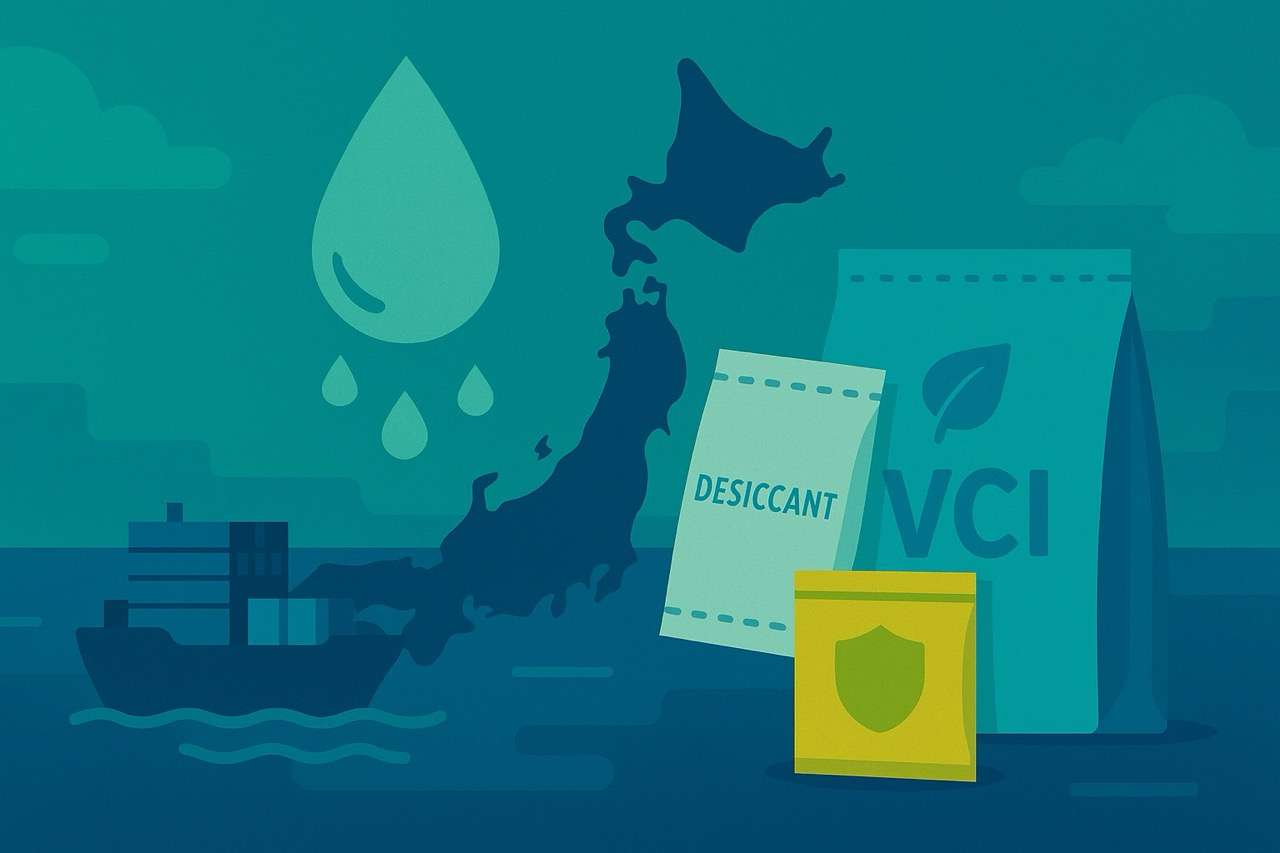
Shipping cargo by sea from China to Japan may seem straightforward given the relatively short distance, but the combination of Japan's humid climate, temperature fluctuations during transit, and extremely strict warehouse acceptance standards makes moisture protection a critical concern. Without proper measures, goods can arrive with mold, rust, or packaging damage—leading to rejection, costly claims, and damaged business relationships.
This guide covers the essential moisture protection methods for Japan-bound sea freight: desiccants, VCI (Volatile Corrosion Inhibitors), and barrier bags. Understanding when and how to use each solution ensures your cargo arrives in perfect condition and meets Japanese quality expectations.
Why Moisture Protection Matters for Japan-Bound Sea Freight
High humidity across Japan year-round
Japan experiences high relative humidity throughout most of the year, particularly during the rainy season (tsuyu) from June to July and the typhoon season from August to October. Average humidity levels in major port cities like Tokyo, Osaka, Yokohama, and Nagoya regularly exceed 70-80%, creating an environment where moisture-related damage can occur rapidly once containers are opened.
Risks during ocean transit: container rain, condensation, corrosion
Even on the relatively short China-to-Japan sea route (typically 3-7 days), containers experience significant temperature variations as they move between different climate zones and through day-night cycles. These fluctuations cause moisture in the air inside the container to condense on cooler surfaces—a phenomenon known as "container rain" or "container sweat." This condensation drips onto cargo, causing damage that may not be immediately visible upon arrival.
Common types of damage: mold, rust, packaging collapse, odor
Moisture damage manifests in several ways depending on the cargo type:
- Mold and mildew: Affects textiles, leather goods, paper products, and wood—often accompanied by musty odors that render products unsellable
- Rust and corrosion: Damages metal parts, machinery, electronics components, and tools
- Packaging collapse: Weakens cardboard boxes and cartons, leading to product damage and poor presentation
- Label degradation: Causes labels to peel, smear, or become illegible—unacceptable in the Japanese market
- Electrical damage: Short circuits and component failure in electronics due to condensation
Why Japanese receivers reject moisture-affected cargo
Japanese businesses operate with extremely high quality standards. Receivers and warehouse operators will reject cargo showing any signs of moisture damage—not just because of the immediate product defect, but because of concerns about long-term quality, hidden damage, and potential liability. A single mold spot on packaging or a hint of rust can result in complete shipment rejection. This zero-tolerance approach makes prevention essential rather than optional.
Important: Japanese warehouse inspections are thorough. Even minor moisture indicators like damp cardboard, humidity stains, or faint odors can trigger rejection and require costly re-inspection or return shipping.
Understanding Moisture Risks: Container Rain & Dew Point Drops
How "container rain" forms during sea freight to Japan
Container rain occurs when warm, moist air inside a shipping container meets the cooler steel walls of the container. As the air cools below its dew point, water vapor condenses into liquid droplets that form on the container ceiling and walls. These droplets eventually fall onto the cargo below—hence the term "container rain."
The moisture source is typically the cargo itself (especially hygroscopic materials like wood, paper, or textiles) and any air trapped inside the container during loading. Even cargo that appears dry can release significant moisture when temperatures change.
Temperature fluctuations during route (China → Japan)
The China-to-Japan shipping route may be short, but containers still experience notable temperature swings:
- Loading in China: Containers may be loaded in hot, humid conditions (especially in southern ports like Shenzhen or Shanghai during summer)
- At sea: Day-night temperature differences can exceed 15-20°C, especially during deck stowage
- Arrival in Japan: Seasonal variations mean containers may arrive in cooler conditions than departure, triggering condensation
- Port waiting time: Containers sitting at Japanese ports before delivery experience additional temperature cycles
Vulnerable goods: electronics, textiles, metals, wood products
Different cargo types face different moisture risks:
| Cargo Type | Primary Risk | Damage Manifestation |
|---|---|---|
| Electronics | Condensation on circuits | Short circuits, component failure, corrosion |
| Textiles/Garments | High moisture absorption | Mold, mildew, odor, staining |
| Metals/Machinery | Surface oxidation | Rust, pitting, coating damage |
| Wood Products | Hygroscopic swelling | Warping, mold, structural weakness |
| Paper/Cardboard | Rapid moisture absorption | Warping, tearing, mold growth |
| Leather Goods | Mold susceptibility | Mold spots, odor, discoloration |
Why short routes still require moisture control
Many shippers mistakenly assume the short China-Japan route doesn't require moisture protection. However, even 3-5 day transits expose cargo to multiple dew point cycles. Additionally, containers often spend several days at origin and destination ports, extending total exposure time. The high ambient humidity in both China and Japan means even brief exposure to condensation conditions can cause significant damage.
Desiccants for Japan Imports: How They Work & When to Use Them
Types of shipping desiccants (clay, calcium chloride, silica gel)
Shipping desiccants are materials that absorb moisture from the air inside containers. The main types include:
Clay Desiccants
Material: Natural montmorillonite clay
Capacity: Absorbs up to 25% of its weight
Best for: Cost-effective protection for moderate humidity
Limitation: Limited capacity; may release moisture if saturated
Calcium Chloride
Material: Hygroscopic salt compound
Capacity: Absorbs up to 300% of its weight
Best for: Long voyages, high-humidity routes
Note: Turns to liquid (brine) as it absorbs—requires leak-proof packaging
Silica Gel
Material: Porous silicon dioxide
Capacity: Absorbs up to 40% of its weight
Best for: Enclosed packaging, electronics, precision items
Advantage: Chemically inert; can be reactivated
Benefits for FCL vs LCL cargo
Full Container Load (FCL): You control the entire container environment. Install container desiccants (hanging poles or blankets) at loading, and include product-level desiccants inside cartons. This dual-layer approach provides comprehensive protection.
Less than Container Load (LCL): You only control your cargo portion. Focus on product-level and carton-level desiccants since you cannot install container-wide protection. Use moisture-indicator cards to verify conditions upon arrival.
Correct placement and load-plan integration
Proper desiccant placement is crucial for effectiveness:
- Hanging desiccants: Install on container walls and ceiling rails, evenly distributed throughout the container
- Floor desiccants: Place on pallets or cargo tops where condensation drips may land
- Product-level: Include inside individual product packaging, especially for electronics and precision items
- Avoid blocking: Ensure desiccants have air exposure—don't cover with plastic or stack cargo directly against them
How to calculate the right desiccant quantity for Japan humidity levels
Desiccant quantity depends on container size, voyage duration, cargo type, and expected humidity. As a general guideline for the China-Japan route:
| Container Size | Minimum Desiccant | Recommended for High-Risk Cargo |
|---|---|---|
| 20ft Container | 6-8 kg calcium chloride equivalent | 10-12 kg |
| 40ft Container | 12-16 kg calcium chloride equivalent | 20-24 kg |
| 40ft High Cube | 14-18 kg calcium chloride equivalent | 22-26 kg |
For hygroscopic cargo (wood, textiles, paper), increase quantities by 30-50%. Always follow manufacturer recommendations for specific desiccant products.
VCI (Volatile Corrosion Inhibitor) Protection for Metals
How VCI works to prevent rust in marine environments
VCI (Volatile Corrosion Inhibitor) products release molecules that vaporize and form an invisible protective layer on metal surfaces. This molecular barrier prevents moisture and oxygen from reaching the metal, stopping the electrochemical reaction that causes rust and corrosion. VCI protection is particularly effective because it reaches all metal surfaces, including recesses and hidden areas that physical barriers cannot cover.
Best applications: machined parts, auto parts, tools, electronics
VCI is essential for protecting:
- Machined metal parts: Precision surfaces that cannot tolerate even microscopic rust
- Automotive components: Engine parts, brake components, fasteners
- Tools and hardware: Hand tools, cutting tools, dies and molds
- Electronics: Circuit boards, connectors, metal housings
- Industrial equipment: Bearings, gears, shafts, machine components
Compatibility with Japanese inspection standards
Japanese quality inspections are extremely thorough for metal products. Any visible corrosion, even light surface oxidation, typically results in rejection. VCI products approved for food-contact or electronics applications are preferred for shipments to Japan, as they leave no residue and don't require removal before use. Always use VCI products from reputable manufacturers with documented specifications that can be provided to Japanese buyers if requested.
Combining VCI with desiccants for maximum protection
For optimal metal protection on the Japan route, combine VCI and desiccants:
- Primary barrier: Wrap metal items in VCI paper or film
- Secondary protection: Include silica gel packets inside the VCI wrapping
- Carton level: Add desiccant pouches inside shipping cartons
- Container level: Install hanging desiccants throughout the container
This layered approach ensures protection even if one system is compromised.
Barrier Bags (Aluminum & Multi-Layer) for High-Value Cargo
What barrier bags protect against (humidity, oxygen, contamination)
Barrier bags are multi-layer pouches or liners that create a complete seal around cargo, protecting against:
- Humidity: Prevents moisture vapor from reaching the product
- Oxygen: Reduces oxidation and corrosion reactions
- Contamination: Blocks dust, dirt, and airborne particles
- Light: Opaque barriers prevent UV degradation
- Odor transfer: Prevents absorption of external smells
When they are mandatory (precision instruments, electronics, optical goods)
Barrier bags are required or strongly recommended for:
- Precision instruments: Measuring equipment, medical devices, laboratory instruments
- Optical products: Lenses, cameras, microscopes, laser equipment
- High-end electronics: Semiconductors, circuit boards, display panels
- Aerospace components: Critical parts with zero-defect requirements
- Pharmaceutical products: Items requiring controlled humidity environments
Many Japanese buyers in these industries specify barrier bag packaging as a purchase requirement.
Heat-sealing requirements & leak testing
Proper barrier bag sealing is critical:
- Heat seal temperature: Follow manufacturer specifications precisely (typically 120-180°C depending on material)
- Seal width: Minimum 10mm for reliable barrier performance
- Desiccant inclusion: Always include appropriate desiccant inside before sealing
- Humidity indicator: Include moisture indicator cards visible through the bag
- Leak testing: For critical items, perform vacuum leak tests on sealed bags
Why Japanese warehouses prefer intact, sealed barrier packaging
Japanese receivers view intact barrier packaging as proof of proper handling throughout the supply chain. An unsealed or damaged barrier bag raises immediate concerns about product integrity, even if no visible damage exists. Warehouses may refuse to accept cargo with compromised barrier packaging or require expensive re-inspection before acceptance.
Choosing the Right Moisture Protection System
Matching solution to cargo type: textiles vs metals vs electronics
| Cargo Type | Primary Protection | Secondary Protection | Container-Level |
|---|---|---|---|
| Textiles/Garments | Desiccants in cartons | Moisture-proof inner bags | Hanging desiccants |
| Metal Parts | VCI wrapping/bags | Silica gel packets | Calcium chloride desiccants |
| Electronics | Barrier bags with desiccant | ESD protection | Hanging desiccants |
| Wood Products | Desiccants in packaging | Moisture barrier wrap | Maximum desiccant quantity |
| Food Products | Food-grade barrier packaging | Approved desiccants | Container desiccants |
FCL vs LCL moisture profiles
FCL Advantages:
- Full control over container preparation and desiccant installation
- No risk of moisture transfer from other shippers' cargo
- Ability to use container-wide moisture barrier liners
- Consistent temperature profile (cargo isn't consolidated)
LCL Challenges:
- Cannot control container-level moisture protection
- Risk of moisture transfer from adjacent cargo
- More handling increases exposure risk
- Must rely entirely on product-level and carton-level protection
Climate considerations at Japanese ports (Tokyo, Osaka, Nagoya, Yokohama)
Seasonal humidity levels affect moisture risk at arrival:
- June-July (Rainy Season): Highest risk period; maximum protection required
- August-October (Typhoon Season): High humidity; potential delays increase exposure time
- November-February (Winter): Lower humidity but temperature differentials can trigger condensation
- March-May (Spring): Moderate humidity; standard protection usually sufficient
Combining methods: desiccants + VCI + barrier bags
For maximum protection, especially for high-value or moisture-sensitive cargo, use a multi-layer approach:
- Product level: VCI film or barrier bag with desiccant
- Carton level: Additional desiccant packets
- Pallet level: Moisture-proof pallet covers or shrink wrap
- Container level: Hanging and floor desiccants
Best Practices for Japan Sea Freight Packaging
Use of pallets covers & moisture-proof liners
Pallet covers provide an additional moisture barrier between container condensation and your cargo:
- Plastic shrink covers: Economical protection for general cargo
- Foil barrier covers: Superior moisture barrier for sensitive items
- Container liners: Full container interior coverage for extremely sensitive cargo or high-humidity routes
Ensure covers extend to the pallet base and are properly sealed to prevent moisture ingress from below.
Correct wrapping, strapping, and pallet height control
Proper cargo securing supports moisture protection:
- Wrapping: Use stretch film to create a moisture-resistant outer layer; overlap layers by 50%
- Strapping: Secure cargo firmly to prevent shifting that could damage moisture barriers
- Pallet height: Keep total height under 1.5m to allow proper air circulation and desiccant effectiveness
- Spacing: Leave gaps between pallets and container walls for air movement
Storing cargo in dry environments before loading
Pre-loading conditions significantly impact in-transit moisture:
- Store cargo in climate-controlled warehouses before container loading
- Ensure packaging materials are dry before use
- Load containers quickly to minimize humidity exposure
- Avoid loading during rain or high-humidity conditions
- Verify container is dry and in good condition before loading
Labeling requirements for Japanese warehouse acceptance
Proper labeling supports smooth warehouse acceptance:
- Moisture-sensitive indicators: Include visible humidity indicator cards
- Handling instructions: Clearly mark "Keep Dry" and protection requirements
- Desiccant information: Note desiccant type and quantity used
- Barrier bag status: Indicate sealed barrier packaging where applicable
Signs of Moisture Damage on Arrival (and What to Do)
Mold spots, wet cartons, rust, odor, deformation
Common indicators of moisture damage to look for:
- Visual signs: Mold spots, water stains, rust, discoloration, warped packaging
- Physical changes: Soft or collapsed cartons, swollen wood, deformed products
- Olfactory indicators: Musty smell, mildew odor, chemical off-gassing
- Humidity indicators: Indicator cards showing high humidity exposure
Taking POD photos for claims
Document damage thoroughly for insurance claims:
- Photograph container exterior and interior before unloading
- Document condition of desiccants and humidity indicators
- Take clear photos of all damaged items with scale reference
- Record date, time, and location on all documentation
- Note damage on delivery receipt (POD) before signing
Survey inspection procedure in Japanese ports
For significant damage, request a professional survey:
- Notify carrier and insurance company immediately upon discovery
- Request independent surveyor appointment
- Preserve damaged cargo and packaging for inspection
- Provide all documentation (B/L, packing list, photos) to surveyor
- Obtain formal survey report for claim submission
Preventing repeat issues through moisture audits
After any moisture incident, conduct a thorough review:
- Analyze packaging methods and materials used
- Review desiccant type, quantity, and placement
- Evaluate pre-loading storage conditions
- Check container condition and loading practices
- Implement corrective measures for future shipments
Protecting Your Japan Supply Chain from Moisture Damage
Moisture control is not optional for sea freight to Japan—it's a fundamental requirement for successful import operations. The combination of high ambient humidity in both China and Japan, temperature fluctuations during transit, and Japan's exacting quality standards means that unprotected cargo faces significant risk of rejection or damage claims.
Key Takeaways:
- Desiccants absorb moisture throughout the container—essential for all Japan-bound sea freight
- VCI products provide targeted corrosion protection for metal components and machinery
- Barrier bags create sealed environments for precision instruments and electronics
- Layered protection combining multiple methods provides the most reliable results
- Proper documentation and labeling support smooth Japanese warehouse acceptance
By implementing appropriate moisture protection measures, you ensure your cargo arrives in the condition Japanese buyers expect—protecting your reputation, avoiding costly claims, and building long-term business relationships in one of the world's most demanding markets.